




Best Couch Covers for Cats That Scratch: Australian Guide

If your cat scratches the sofa, a cover can protect the original upholstery—but no fabric should be treated as completely cat-proof. Cats scratch to stretch, maintain their claws, mark an area and express normal behaviour. The most effective plan combines a replaceable protective layer with an appealing scratching surface in the right location.
The best couch cover for cats that scratch has a stable, closely constructed surface and covers the exact places the cat targets. That might be the outside of one arm, a cushion edge, the front corner or the top of the backrest. Protecting the target zone is more useful than draping a beautiful throw across the middle of the seat.
This Australian guide explains how to choose a realistic cat couch protector, which fabric characteristics to compare and how to arrange the room so the scratching post is easier to choose than the sofa.
Quick answer: what type of cover is best for scratching cats?
Choose a dense surface with minimal loose loops, enough structure to remain flat and a fit that does not pull away from the sofa. Cover the arm and corner if those are the scratching points. Use the cover as damage reduction, not as a promise that claws cannot penetrate it.
Why “cat scratch-proof couch cover” is an unrealistic promise
A determined cat can damage many textiles, especially when the cover moves or offers satisfying resistance. “Scratch-resistant” is more realistic: the cover may tolerate normal contact and reduce direct wear on the upholstery, but repeated forceful scratching can still mark, snag or tear it.
Honest expectations matter because they change the setup. Instead of relying on one fabric, you protect the target zone, stabilise the cover and provide an alternative scratching surface nearby.
Map your cat's scratching zones first
- Observe when it happens. Some cats scratch after waking; others do it near a doorway or before climbing onto the sofa.
- Identify the exact surface. Note whether the claws contact the outside arm, front edge, seat, backrest or underside.
- Measure the whole movement. The protected area should cover the full upward or sideways stretch, not only the visible marks.
- Place an alternative beside it. A scratching post or pad is more likely to be used when it is close to the established location.
- Review after a week. Adjust the cover and scratching option according to what the cat actually chooses.
Fabric characteristics to compare
| Characteristic | Why it matters for cats | What to avoid |
|---|---|---|
| Surface density | A close construction offers fewer obvious loops for claws to catch | Very open decorative weaves in a target zone |
| Stability | A flat cover is less likely to pull away and expose upholstery | Loose throws over rounded arms |
| Coverage | Protects the full scratch path and landing area | Seat-only protection when the arm is the target |
| Replaceability | Individual pieces let the high-wear section be changed separately | One large cover that must be replaced for one damaged corner |
| Care | Hair, dander and everyday dirt can be removed regularly | Care requirements that do not suit your routine |
Can chenille work in a home with cats?
It can, depending on the actual weave and the cat's behaviour. Chenille is a broad material description, not a guarantee of claw resistance. Compare close-up photos, surface density, backing and stability. If your cat repeatedly digs into fabric, no decorative cover should be expected to remain unmarked.
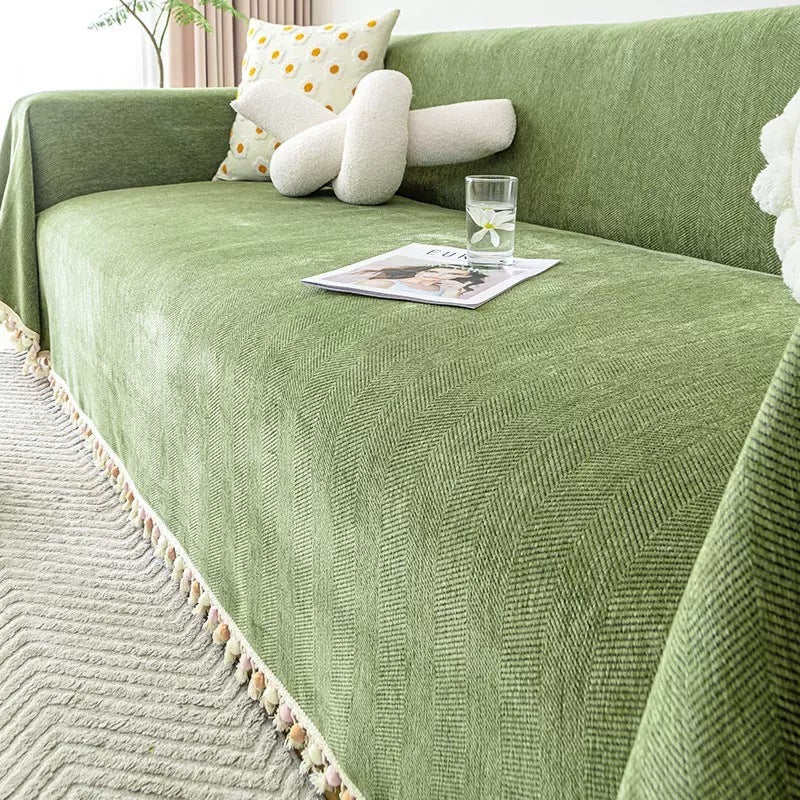
A textured chenille cover can be comfortable and visually forgiving for normal lounging. In a scratch target zone, make sure it sits flat and pair it with a more satisfying scratching option.

Fitted versus unfitted covers for cats
A fully fitted slipcover can provide broad coverage, but it may be difficult to find for unusual sofa shapes. Separate unfitted pieces can protect individual arms, seats and backs and may be easier to replace. The better option is the one that remains stable on your specific furniture.
For rounded arms, make sure the cover has enough contact and does not hang as a narrow strip that a cat can pull aside. For modular sofas, individual pieces can follow the cushions more closely. For recliners, do not obstruct mechanisms or allow loose material near moving gaps.
Create a cat-friendly scratching alternative
A cover protects furniture; it does not remove the need to scratch. Improve the alternative rather than only blocking the sofa.
- Match orientation: use a tall stable post for vertical scratchers and a broad pad for horizontal scratchers.
- Match location: place it next to the sofa area already being used.
- Make it stable: a post that wobbles may be less appealing than a solid sofa arm.
- Reward the right choice: use calm praise, play or another positive reward when the cat uses it.
- Keep it available: do not move the alternative away as soon as the behaviour improves.
Avoid punishment or frightening deterrents. If scratching is sudden, intense or linked with other behaviour changes, seek advice from a veterinarian or qualified cat-behaviour professional.
How to protect the arm, corner and cushion edge
Sofa arms
Measure the outside face, top and inner edge. A piece that covers only the top may leave the vertical scratching surface exposed. Make sure the material cannot slide down during a full-body stretch.
Front corners
Corners need enough wrap to stay covered when the cat pulls sideways. Separate pieces may be easier to reset than one large throw that shifts across the entire sofa.
Cushion edges
Protect the front and side edge as well as the top. Check beneath the cover regularly: a displaced corner can hide ongoing upholstery damage.
Backrests
If the cat climbs or sleeps along the top, cover both the top surface and the side used for access. Ensure the piece remains secure and does not create an unstable launch point.
What if the home has cats and dogs?
Mixed-pet homes need a broader checklist. Cats bring claw and climbing behaviour; dogs may add hair, moisture and stronger movement. Prioritise stable coverage first, then choose the protection level for the mess most likely to damage the sofa.
If dog hair is the daily problem, read our guide to covers for dogs that shed. If wet paws or accidents are common, compare waterproof dog couch covers. The main pet couch cover buying guide brings all of the priorities together.
Snug & Homely options to compare
The HerriLoom Chenille Herringbone Non-Slip Sofa Cover is currently described with a soft chenille feel, herringbone texture and non-slip design. It can be considered for everyday pet hair, dust and light wear where a decorative finish matters.
The LuxeGuard Waterproof Pet-Friendly Chenille Sofa Cover is currently described with waterproof multi-layer protection and anti-slip backing, and as helping protect against pet hair, light scratches and everyday mess. It may be the more relevant comparison in mixed-pet homes where liquid protection is also needed.
Neither should be treated as indestructible. Both are sold as individual pieces, so measure each target zone and check the current product information before ordering.
Cat couch-cover maintenance
- Remove loose hair before it builds up around folds and edges.
- Check the target zone frequently for snags or movement.
- Trim loose threads rather than pulling them, if the product guidance allows.
- Lift the cover and inspect the upholstery underneath.
- Follow the exact care label for washing and drying.
- Replace a damaged piece if it creates loose material that could catch a claw.
Common mistakes to avoid
- Covering the seat when the cat scratches the outside arm.
- Choosing a loose open weave because it looks thick.
- Expecting a cover to change behaviour by itself.
- Placing the scratching post in another room.
- Using unsafe pins, exposed fasteners or unstable accessories.
- Failing to check beneath a cover that has shifted.
Frequently asked questions
Is there a truly cat scratch-proof couch cover?
No fabric cover should be considered completely scratch-proof. A dense, stable cover can reduce direct upholstery damage, but repeated scratching may still mark or tear it.
What fabric do cats dislike scratching?
Cats have individual preferences, and choosing a disliked fabric is unreliable. Focus on stable protection and offer a more suitable scratching surface with the orientation and location the cat prefers.
Will a couch cover stop scratching behaviour?
No. It changes the protected surface. The behavioural need remains, so provide a scratching post or pad and reward its use.
Should I cover the entire couch?
Full coverage is useful when the cat climbs across the whole sofa. If one arm is the established target, a securely protected zone may be neater and easier to maintain.
Are non-slip covers better for cats?
Stability is valuable because a moving cover exposes upholstery. Non-slip construction can help, but correct sizing and contact with the sofa remain essential.
Final recommendation
Choose coverage and stability over dramatic marketing claims. Protect the full scratching path, favour a closely constructed surface and make the approved scratching alternative more convenient than the sofa. That combination gives the cover a fair chance to protect your furniture while respecting normal cat behaviour.
Compare the current pet-friendly sofa covers, then use the sofa size guide to plan the right pieces for your cat's target zones.
Disclaimer
This guide provides general information. Materials, dimensions, protection features and care requirements vary by product. Refer to the individual product page for current specifications before purchasing.
How to Protect Your Couch From Dogs in Australia: Fur, Mud, Scratches & Accidents
LuxeGuard Plush Chenille Sofa Cover: Waterproof & Pet-Friendly Guide (2026)
Continue reading


How to Choose the Perfect Sofa Cover for Any Couch

Scratch-Proof Style: Pet-Friendly Sofa Covers That Actually Look Good

LuxeGuard Plush Chenille Sofa Cover: Waterproof & Pet-Friendly Guide (2026)

How to Protect Your Couch From Dogs in Australia: Fur, Mud, Scratches & Accidents

Why LuxeChenille Sofa Wrap Is the Easiest Way to Upgrade Your Living Room
