


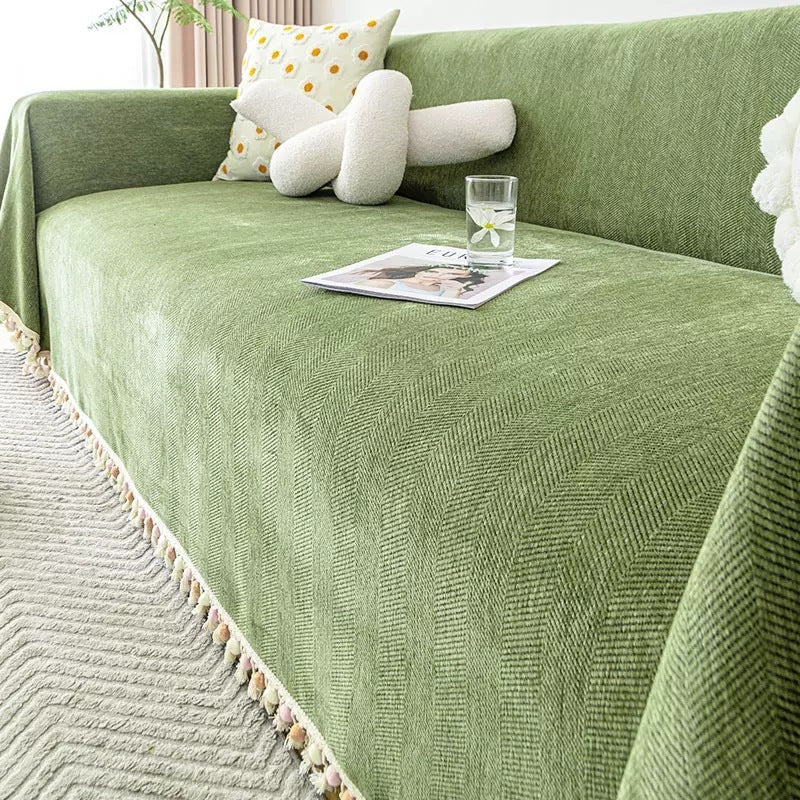


How to Measure a Sofa for a Cover: Size Guide | Snug & Homely

Need the quick version? Use our Sofa Size Guide page for the shorter measuring checklist.
Quick answer: To measure a sofa for a cover, record the complete outside width from the outer edge of one armrest to the outer edge of the other. Then measure the sofa's total depth, height, seat width, seat depth and arm shape. For an L-shaped or modular sofa, measure each connected section separately. Always compare your measurements in centimetres with the size chart on the exact product page.
This Australian couch cover size guide explains how to measure a couch for a slipcover, throw-style cover or fitted stretch sofa cover. It includes practical instructions for armchairs, two-seater, three-seater and four-seater sofas, recliners, sofa beds, chaise lounges and L-shaped couches.
What measurements do you need for a sofa cover?
Most couch cover measurements are based on six dimensions. Write every result in centimetres and label it clearly before shopping.
| Measurement | Where to measure | Why it matters |
|---|---|---|
| Overall width | Outer arm edge to outer arm edge | Main measurement for one-piece stretch couch covers |
| Overall height | Floor to the highest point of the backrest | Checks whether the cover can reach over the back |
| Overall depth | Furthest front point to furthest rear point | Important for deep lounges and oversized sofas |
| Seat width | Inside one armrest to inside the other | Used for seat protectors and separate cushion covers |
| Seat depth | Front of the seat to the base of the backrest | Helps assess coverage and tucking space |
| Arm dimensions | Width, height and depth of each arm | Essential for wide, rolled, curved or high arms |
What you need before measuring your couch
- A flexible measuring tape
- A pen and paper or notes app
- A simple top-view sketch of the sofa
- Another person to hold the tape for a large lounge
- The size guide for the exact sofa cover you want to buy
A flexible tape is easier to position around cushions and curved armrests than a rigid building tape. Remove loose throws, decorative cushions and other items before measuring, but leave the normal seat and back cushions in place when measuring the complete sofa.
How to measure a sofa for a cover: step by step
Step 1: Measure the full outside width
Stand in front of the sofa and stretch the measuring tape in a straight horizontal line from the outermost point of the left armrest to the outermost point of the right armrest. Include both arms.
This arm-to-arm sofa measurement is the most important number for many fitted couch covers and universal stretch slipcovers. Do not measure only the seating space between the arms.
Step 2: Measure the total sofa height
Measure vertically from the floor to the highest point of the backrest. Include the legs unless the instructions for the selected cover tell you not to. If the back is curved, use the highest point.
Step 3: Measure the overall depth
Measure along the side from the furthest point at the front to the furthest point at the rear. Do not confuse overall sofa depth with seat depth. Australian lounge furniture can be especially deep, so this measurement helps identify whether a standard cover has enough fabric.
Step 4: Measure the usable seat
Measure the seat width between the inside edges of the armrests. Then measure the seat depth from the front of the cushion to the point where the seat meets the backrest. These measurements matter when buying individual couch cushion covers, non-slip sofa protector panels or throw-style lounge covers.
Step 5: Measure the armrests
Record the maximum width, height and depth of each arm. Thick rolled arms require more fabric than narrow square arms, even when two sofas have the same overall width.
Step 6: Record the sofa shape and cushion layout
Note whether your couch has fixed cushions, removable cushions, a bench seat, a high back, low arms, a curved frame, a chaise, a corner module or a reclining footrest. Take a front and side photo for reference before choosing a cover.
How to measure for different types of sofa covers
The correct measuring method depends on whether you are buying a stretch slipcover, an unfitted sofa throw, a full-coverage couch protector or separate cushion covers.
One-piece stretch sofa covers
For a one-piece stretch sofa cover, begin with the widest outside arm-to-arm measurement. Compare that number with the exact product range, then check the sofa height, depth and arm shape.
Stretch sofa covers are designed to expand within a stated range. A cover that is too small can strain at the seams, expose part of the sofa or pull out of the seat gaps. A cover that is too large may bunch, move or look loose.
Full-coverage and unfitted sofa covers
An unfitted or rectangular full-coverage sofa cover sits over the furniture rather than wrapping tightly around the complete frame. For this style, measure the total path the fabric must cover.
- For the front-to-back measurement, start near the bottom front of the sofa.
- Measure up the front, across the seat, over the backrest and down the rear.
- For the side-to-side measurement, start below one outer arm.
- Measure over the first arm, across the seats, over the second arm and down the opposite side.
Check how much extra fabric the product requires for tucking. Do not add an arbitrary allowance unless the product instructions recommend it.
Separate seat and back cushion covers
Remove each cushion and measure its width, depth and maximum thickness. Measure T-shaped cushions at both their narrowest and widest points. Label every result, because cushions that look identical can vary by a few centimetres.
Sofa protectors and couch throws
For a sofa protector, measure the seating width, seat depth, backrest height and arm coverage separately. This is useful when choosing a washable sofa cover for pets, children, spills or daily wear. If the protector has a non-slip backing, confirm that its dimensions cover the high-use seating areas without blocking reclining mechanisms.
Sofa cover size chart for Snug & Homely
The current width ranges for the Stretchy Nordic-Style All-Season Sofa Cover are shown below. Measure the complete outside width, including both armrests.
| Cover option | Sofa width | Measure |
|---|---|---|
| Two-seater sofa cover | 110–160 cm | Outer arm to outer arm |
| Three-seater sofa cover | 160–195 cm | Outer arm to outer arm |
| Four-seater sofa cover | 195–230 cm | Outer arm to outer arm |
These dimensions apply to this product only. Sofa cover sizes differ between materials, designs and brands, so always use the size chart on the exact product page.
What size couch cover do I need?
Use the sofa's measurement in centimetres rather than relying only on the number of seats. A two-seater with oversized arms can be wider than a compact three-seater.
How to choose a two-seater couch cover
For a 2 seater couch cover in Australia, measure the entire width from the outside of one arm to the outside of the other. Also check the height and depth. For the stretch cover in the chart above, the two-seater option fits sofa widths of 110–160 cm.
How to choose a three-seater couch cover
A three-seater lounge may have two large cushions, three separate cushions or one bench cushion. Cushion count does not determine the cover size. Use the complete external width. For the product above, the 3 seater couch cover range is 160–195 cm.
How to choose a four-seater couch cover
Ask another person to hold the tape straight across a large sofa. For the product above, the 4 seater sofa cover range is 195–230 cm. If your lounge is wider than the listed range, do not force the smaller cover over it.
How to measure an armchair or one-seater
Measure the outer width, height and depth of the chair, then record the seat and arm dimensions. An armchair cover must match the chair's shape as well as its width, particularly when the chair has wings, rolled arms or a reclining function.
How to measure an L-shaped sofa for a cover
L-shaped couch covers in Australia are commonly supplied as separate pieces because the main sofa and chaise are different sections. Do not measure diagonally across the complete L shape.
- Identify where the main sofa connects to the chaise or return.
- Measure the outside width of the main section.
- Measure the outside length and width of the chaise section.
- Record the height and depth of both sections.
- Measure each corner or centre module separately.
- Record whether the chaise is on the left or right when facing the sofa.
Draw a simple top-view diagram and add every measurement to it. This makes sectional sofa cover sizing easier and helps prevent the main body and chaise measurements from being confused.
How many covers are needed for an L-shaped couch?
Many L-shaped sofas require at least two covers: one for the main sofa and one for the chaise or second section. A larger modular sofa may require one correctly sized cover for each detachable module. Check the individual product description before ordering.
How to measure a true corner sofa
Divide the layout at the internal corner. Measure each wing from the outside arm to its connection with the corner section. Then measure the corner seat, overall depth and back height. Avoid treating a true corner couch as one straight sofa.
How to measure recliners and sofa beds
Recliner couch cover measurements
Measure a recliner in both its closed and fully extended positions. Record the outside width, backrest height, seat width, seat depth, arm dimensions and footrest length. Make sure the selected recliner cover does not block a manual lever, electric control, cable or moving joint.
Sofa bed cover measurements
Measure the sofa bed while it is closed for a standard couch cover. If the cover will remain on while the bed opens, also measure the extended length and confirm that the product is designed for this use. Note any split backrests, storage compartments or folding sections.
How to measure unusual sofa shapes
High-back sofa
Measure from the floor to the highest point of the backrest and record the rear depth. High-back sofas need enough fabric to travel over the top without pulling the cover away from the seat.
Rolled-arm or wide-arm sofa
Measure the complete outer width and the maximum circumference or width of each arm. Rolled arms use more fabric than slim square arms.
Armless sofa
Measure the full body width, height and depth. Confirm that the cover is designed for an armless sofa; a standard cover with shaped arm sections may not sit correctly.
Curved couch
Record the straight-line outside width as well as the curved front-edge measurement. Take a top-view photo or sketch. Universal rectangular covers may provide better coverage than highly fitted slipcovers on unusual curves, depending on the product design.
Leather couch
Use the same size measurements, but also look for a non-slip couch cover or a product with suitable fixing methods. Smooth leather can allow an unfitted cover to move more than textured fabric upholstery.
Common sofa cover fit problems and how to avoid them
The cover is too tight
The sofa may have been measured between the arms instead of across their outer edges. Recheck the complete outside width and compare it with the exact cover range. Thick arms, a deep seat or a tall back can also require more fabric.
The cover is loose or bunching
The cover may be too large, insufficiently tucked or unsuitable for the sofa shape. Smooth the material evenly from the centre towards the arms and use only the fixing accessories supplied or recommended for that cover.
The cover keeps slipping
Confirm that the product is suitable for the upholstery material. A non-slip couch cover may be a better choice for leather, active family rooms or homes with pets. Correct sizing is essential because excess material can move during everyday use.
The arms or back are exposed
Check the sofa's height, depth and arm dimensions. The external width alone may fall inside the listed range while the sofa's unusually deep or high shape still affects coverage.
The cover blocks the recliner
Use a cover designed for reclining furniture and make sure the controls and moving sections remain clear. A standard one-piece slipcover may not suit every recliner design.
Which sofa cover is best for your household?
Once the size is confirmed, choose the cover style around the way your sofa is used.
- Busy family room: Consider an easy-care, washable sofa cover.
- Homes with cats or dogs: Look for a pet-friendly sofa protector with practical coverage.
- Smooth leather lounge: Prioritise a secure or non-slip couch cover.
- Everyday spills: Check the product's stated water-resistance or waterproof protection.
- Older sofa needing a new look: A fitted stretch couch cover can refresh the complete silhouette.
- Sectional lounge: Choose separate covers for the main section, chaise and modules.
Compare materials and protection options in our guide to the best sofa covers Australia. Pet owners can also explore our pet-friendly sofa cover guide.
Final couch cover buying checklist
- Record every measurement in centimetres.
- Measure the widest outside points, including the arms.
- Check the height and depth, not only the width.
- Measure removable cushions individually when required.
- Treat each L-shaped or modular section separately.
- Check whether a chaise is left-facing or right-facing.
- Confirm that a recliner cover allows the chair to move safely.
- Use the size chart on the exact product page.
- Save a front, side and top-view photo for reference.
- Choose the cover by centimetres and sofa shape, not seat count alone.
Frequently asked questions about sofa cover sizes
How do I measure a sofa for a cover?
Measure from the outside of one armrest to the outside of the other. Then record the total height, overall depth, seat width, seat depth and arm dimensions. Compare the results with the size chart for the exact cover.
How do I know what sofa cover size I need?
Match your sofa's complete outside width in centimetres with the product's stated range. Use the height, depth and arm shape as additional fit checks. Do not choose only by the number of seats.
Do I measure a couch from the inside or outside of the arms?
For most one-piece stretch covers, measure from the outside edge of one arm to the outside edge of the other. The inside measurement is mainly used for seat protectors and individual cushion covers.
What size cover fits a two-seater sofa?
The correct size depends on the product. For the Snug & Homely stretch cover featured above, the two-seater option fits outside sofa widths of 110–160 cm.
What size cover fits a three-seater couch?
For the Snug & Homely stretch cover featured above, the three-seater option fits outside widths of 160–195 cm. Measure the sofa rather than relying on cushion count.
What size cover fits a four-seater lounge?
For the featured stretch cover, the four-seater option fits outside sofa widths of 195–230 cm. Check the exact product page before ordering because size ranges vary.
What should I do if my couch is between two cover sizes?
Recheck the measurement, then compare the sofa's depth, back height and arm thickness with the product instructions. Do not automatically size up or down without checking the exact cover design and stretch range.
Can a universal sofa cover fit any couch?
No cover fits every furniture shape. Universal stretch covers can suit many standard sofas within their stated dimensions, but unusual arms, fixed cushions, recliners, sofa beds and curved frames may need a different design.
How many covers do I need for an L-shaped sofa?
Many L-shaped couches need two covers: one for the main section and one for the chaise. Modular sofas may need a separate cover for each detachable section. Check the product description before purchasing.
How do I measure couch cushions for separate covers?
Remove each cushion and measure its width, depth and maximum thickness. For T-shaped cushions, record both the narrow and wide sections. Label each cushion measurement separately.
Can I use a fitted couch cover on a leather sofa?
It depends on the product. Check that the cover is suitable for leather and includes a secure fitting method. A non-slip design may help reduce movement on smooth upholstery.
Are sofa and couch measurements the same?
Yes. In Australia, sofa, couch and lounge are often used for the same type of furniture. The measuring method remains the same: record the complete width, height, depth, seat and arm dimensions.
Measure once and choose with confidence
Accurate sofa measurements help a cover sit securely, protect more of the upholstery and create a neater finish. Measure in centimetres, include both armrests, record the complete sofa shape and compare every result with the exact product size chart.
Compare your measurements with the Stretchy Nordic-Style All-Season Sofa Cover.
More size-specific help: 2-seater couch covers, 3-seater sofa covers, 4-seater lounge covers, and L-shaped & modular couch covers.
How to Clean a Couch: Fabric & Stain Guide | Snug & Homely
2-Seater Couch Covers Australia: Size, Fit & Buying Guide
Continue reading

Sofa Throw vs Sofa Cover: Which Is Better for Australian Homes?

Couch Protector vs Sofa Cover: What’s the Difference?

Recliner Sofa Covers Australia: How to Measure and Check Compatibility

Sofa Cushion Covers vs Full Sofa Covers: Which Is Better?

Armchair Covers Australia: Fit, Fabric and Measuring Guide

Best Waterproof Couch Covers for Dogs in Australia: What Works?

How to Stop a Couch Cover From Sliding
