


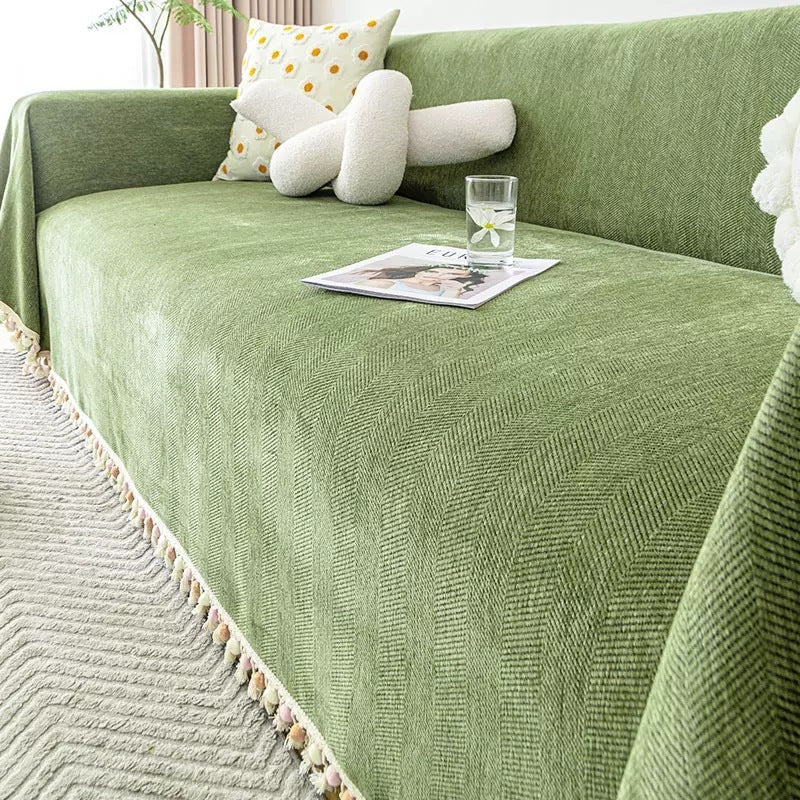


Dual-Sided Geometric Jacquard Sofa Cover: Cotton Chenille with a Graphic Finish

A geometric sofa cover can give a quiet room a stronger point of view. Instead of adding several decorative objects, you introduce one broad surface of colour, repeated shapes and woven texture. The sofa remains the furniture you already know, but the room sees it differently.
The Dual-Sided Geometric Jacquard Anti-Slip Sofa Cover is an option for that kind of change. Its current page describes 100% cotton chenille, a two-sided geometric jacquard design, anti-slip backing and a lightweight feel. It is offered in five rectangular sizes rather than fitted seating categories.
For an Australian apartment or lounge with simple walls and plain upholstery, those features can be appealing. A graphic cover can become the main decorative element while leaving the rest of the room relatively restrained. The cotton chenille description also gives shoppers a specific material to consider rather than an unspecified decorative throw.
The buying decision still needs care. Two-sided design does not automatically explain how the backing works on each face, and “easy to maintain” does not provide an exact washing method. This guide combines the styling benefit with sizing, grip and care questions, so you can assess the product as something you will actually live with.
The current product facts
The listing identifies the fabric as soft, breathable 100% cotton chenille. It describes a dual-sided geometric jacquard pattern, anti-slip backing and a light, cosy surface without bulk. Spring and autumn are specifically mentioned as suitable seasons.
The current size choices are 130 × 180, 180 × 230, 230 × 250, 230 × 275 and 230 × 340 cm. The package contains one sofa cover. The available style is named Geometric pattern.
In this guide
- The current product facts
- 1. The decorative benefit of one strong geometric surface
- 2. Cotton chenille: a material and a surface character
- 3. What a two-sided design can offer
- 4. Keep the room calm around the pattern
- 5. Choose between a full feature and a smaller layer
- 6. Compare the five rectangles with real fabric routes
- 7. A worked example for a graphic seat-and-back drape
- 8. Use the jacquard pattern to guide a deliberate drape
- 9. Anti-slip backing and ordinary movement
- 10. Spring and autumn suitability in an Australian lounge
- 11. Easy maintenance still needs an exact method
- 12. Protection benefits without stronger promises
- 13. Review value as a complete buying decision
- Frequently asked questions
- Make one graphic choice with a practical plan
1. The decorative benefit of one strong geometric surface
A graphic textile can organise the room visually. Repeated shapes create a rhythm across the sofa, while the surrounding plain surfaces give that rhythm space. It can be an effective option when a lounge feels bland but you do not want to change the main furniture.
Think about the scale of the cover in the room. The same design may look lively on a seat layer and much more dominant when draped over the back and both arms. Decide how much of the pattern you want visible before choosing the rectangle.
A cover can also connect colours that already exist separately. A warm timber table, a darker lamp and a quiet wall colour may feel more related when the textile provides a deliberate bridge. You do not need every colour to appear in every accessory.
Use the current gallery to judge the actual design. The article's styling illustration suggests one room arrangement, but the live product photo is the purchase reference. A geometric name alone cannot tell you the full palette, repeat scale or appearance of the selected face.
2. Cotton chenille: a material and a surface character
The current page specifies 100% cotton chenille. Cotton identifies the listed fibre, while chenille describes the textured character of the textile. Both details are relevant to a shopper who wants a soft surface with a woven visual presence.
The listing also describes the fabric as breathable and lightweight. Treat those as the supplied product characteristics rather than as a quantified temperature-control system. No cooling rating, fabric weight or insulation measurement is provided in the information reviewed for this guide.
Texture preference varies. Some people enjoy a soft raised surface; others prefer a smoother or more tightly finished textile. If the feel is your deciding factor, ask for additional detail about the actual cover rather than relying on an interior photograph.
The listed cotton content does not establish an organic certification, local manufacturing origin or environmental footprint. Those are separate questions requiring separate evidence. Choose around the information supplied, and request documentation if certification is part of your buying criteria.
3. What a two-sided design can offer
A two-sided design may give you more visual flexibility than a textile with only one presentable face. You might be able to change the visible expression of the pattern or use the alternative side according to the product's intended construction.
However, this product also lists anti-slip backing. That combination deserves clarification before you assume both faces offer identical function. A decorative reverse and a backed contact surface are not necessarily interchangeable in the way you might expect from the phrase dual sided.
Ask the store which face is intended to sit against the sofa, whether reversing is permitted in ordinary use and whether the grip feature works the same way on both. Request photographs of both faces if their appearance is important to your choice.
Once clarified, use the feature as instructed. Do not promote reversal as a guaranteed second anti-slip arrangement or a way to postpone cleaning a marked side. A different visible face does not remove debris, moisture or care requirements from the textile.
4. Keep the room calm around the pattern
Start with the cover and your existing furniture. A strongly patterned sofa often benefits from simple surrounding objects: a plain cushion, an uncluttered side table and a rug that does not compete at the same visual scale.
If your rug already has a bold geometric design, compare the two together before adding another pattern. Different scales or a shared colour can sometimes work, but similar high-contrast repeats may feel busy. A photograph of the full room is more useful than a close-up of each item separately.
Plain curtains can provide a quiet backdrop, while a small artwork may echo one tone without duplicating the entire design. Avoid buying accessories simply because their name also includes geometric. The actual relationship of colour, scale and shape matters more.
In an Australian city apartment, the sofa may be visible from the kitchen or dining table. Consider those views as part of the composition. A large graphic cover has a room-wide effect, so assess it in the space where you will see it every day.
5. Choose between a full feature and a smaller layer
A large drape can make the sofa the room's main feature. It may also conceal more of the original upholstery colour. This approach requires careful measurement of the back and arms, because the textile has to travel over them.
A smaller seat layer leaves more original upholstery visible. That can be useful when you like the sofa colour and simply want to introduce texture and pattern. It also makes the cover read clearly as an added textile rather than a replacement upholstery skin.
A backrest-focused arrangement creates a different balance again. The pattern appears behind the seating area while the original seat remains prominent. The size choice should reflect the intended route and any drop over the rear.
Sketch your preferred arrangement before buying. If the room image shows broad coverage, do not expect the smallest rectangle to reproduce it on a larger sofa. Equally, a large rectangle may be unnecessary if you only want a measured accent.
6. Compare the five rectangles with real fabric routes
The 130 × 180 cm option is a different shape and coverage capacity from the 230 × 340 cm option. Do not read the size range as a simple small-to-large list of universal sofa categories. Each rectangle needs to be compared in both directions.
Measure the route the fabric will follow. Across the sofa, that may include the seating span, the inner arm faces, the arm tops and the outside drops. From front to back, it may include the rear allowance, backrest, seat depth and front drop.
The available intermediate options are 180 × 230, 230 × 250 and 230 × 275 cm. They can be useful to assess when a particular route needs a wider rectangle rather than merely additional length. The right choice depends on the layout you have measured.
Rotate the rectangle in your plan if necessary, then consider how that orientation affects the pattern and the intended backing. Do not assume the design looks or functions identically in every direction. Ask for advice if the orientation is essential to fit.
Leave room for a sensible tuck only where the product instructions allow it. A measurement that barely equals the flat surface may not provide the finished arrangement you want. Excessive surplus can also create bulky folds or drops near the floor.
7. A worked example for a graphic seat-and-back drape
Consider a hypothetical sofa arrangement requiring a 215 cm side-to-side route and a 225 cm front-to-back route. A 230 × 250 cm rectangle could be worth investigating if its orientation and remaining allowances match the intended appearance.
The apparent margin is only the beginning of the decision. You would check the accuracy of the route measurements, the amount reserved for tucking and whether the decorative edges fall where you want them. A geometric repeat may also look different when folded over arms.
If the intended route changes to include deeper side drops, the required side-to-side dimension may increase. The same candidate rectangle may no longer be suitable. That is why measuring the final plan is more reliable than using a standard seating label.
The example is hypothetical, not a tested fit. Your sofa's back height, cushion construction and arm shape can change the result substantially. Use the store's size guide and supply photographs when requesting a recommendation.
8. Use the jacquard pattern to guide a deliberate drape
A repeated geometric design gives you visual lines to work with. Centre a useful portion of the pattern on the main seating area, then balance the drops. You do not need perfect mathematical symmetry, but an obviously tilted arrangement may look accidental.
Spread the cover fully before making small adjustments. Pulling only the visible front edge can shift the design across the back or shorten one side. Move the rectangle as a whole when the main alignment is wrong, then refine the folds around the arms.
Allow the textile to follow the sofa's shape. A draped cover is not expected to reproduce a tailored fitted silhouette. Large folds, however, should not become uncomfortable beneath someone sitting or conceal controls on a moving sofa.
Check the view from the doorway and from the side. A layout can look balanced from the front but reveal an uneven rear or side drop. This matters where the sofa stands within an open-plan room rather than directly against a wall.
Decorative edges, if visible on your actual option, should remain clear of walking routes and mechanisms. Ask whether the stated dimensions include any fringe if that detail affects your sizing calculation.
9. Anti-slip backing and ordinary movement
The listed anti-slip backing is a practical feature because a broad rectangle is otherwise dependent on its drape and the furniture beneath. It is intended to help with positioning, but no universal movement-free guarantee is provided.
A smooth sofa finish, loose cushions or an uneven distribution of fabric can affect the result. A person sliding across a seat may also pull the textile. Grip should be assessed during the use you actually expect, not solely while the room is arranged for a photograph.
Follow the orientation instructions, especially because the cover is described as dual sided. Install it on clean, dry upholstery and check whether the backing is suitable for any delicate finish. Avoid assuming the reverse face offers the same contact surface.
If movement persists, revisit the size and fabric distribution. Do not add adhesive, pins or unsupported fixings to force the cover into place. The best result comes from compatible furniture, an appropriate rectangle and the intended installation method.
10. Spring and autumn suitability in an Australian lounge
The product page specifically mentions spring and autumn and describes lightweight comfort without bulk. That can be relevant if you want a textile layer for a lounge that does not need a heavy blanket-like feel.
Australia's indoor conditions vary widely between homes and locations. A sunlit apartment, a draughty older house and a room with air conditioning can feel very different during the same month. Choose the cover around your room and preference rather than assuming a season label settles comfort.
The cover does not provide a published cooling technology or thermal rating. Its stated material and surface can be considered as part of ordinary textile comfort, while fans, ventilation and heating remain separate aspects of the room.
You can also change how much cover is visible rather than changing the whole room each season. A smaller layered arrangement may suit your preferred look at one time, while a broader drape may suit another, provided both are compatible with the product instructions and dimensions.
11. Easy maintenance still needs an exact method
The current description says the cover is easy to clean and maintain, but it does not publish a specific wash temperature, machine programme or drying instruction. Ask for the care label before buying if regular washing is central to your decision.
Do not infer machine washability from 100% cotton alone. The construction, backing and decorative finish are also part of the product. Instructions for a cotton bed sheet or another chenille cover do not establish the correct method here.
Once you have the label, consider the size of the selected rectangle and the equipment or service required for its approved care. A broad 230 cm piece may need more handling and drying space than the smallest option. Practical care is part of choosing the size.
For ordinary surface attention, treat the texture and any fringe gently. Avoid aggressive brushing or unapproved cleaners. If a mark needs more than simple approved care, ask for guidance rather than testing a strong household recipe on a prominent patterned surface.
Remove the cover periodically to inspect and maintain the sofa underneath according to its own instructions. Both layers need access and attention. A patterned cover can make some marks less visually obvious, but that is not a reason to leave them untreated.
12. Protection benefits without stronger promises
A removable textile can receive some dust and routine contact on the surfaces it covers. It can also give you a layer to lift away when you need access to the sofa. Those benefits fit the product's role as a decorative furniture cover.
The current page does not establish a waterproof barrier or claw-proof rating. A drink spill can reach the upholstery, and determined scratching can damage textile. Do not treat the graphic design or cotton content as evidence of a stronger protective function.
Areas outside the rectangle remain exposed. Even a generous drape can leave openings or shift during use. Check the arrangement after ordinary sitting, particularly if protection of a specific area is the main reason you are buying.
The cover is also not a structural repair. It can refresh the room's appearance and surface character while the sofa remains the same underlying piece of furniture. Evaluate sagging cushions or frame damage separately before deciding how much a textile change can accomplish.
13. Review value as a complete buying decision
Compare the selected size's current price, not a price attached to another rectangle in the range. Check the actual option, quantity, delivery information and store policies on the live page before ordering.
One cover is supplied according to the packing description. If you want to dress a second sofa or use separate rectangles on a complex layout, include those additional items explicitly. Plain cushions and accessories shown in images should not be assumed to arrive with the cover.
The value may be strongest when the pattern provides the room change you want without several extra decorating purchases. It may be weaker if you need a fitted contour or a verified liquid barrier that this listing does not provide.
Decide which benefit matters most: listed cotton chenille, graphic styling, a broad draped surface or the clarified two-sided design. A clear priority helps you compare this product fairly with other cover formats rather than choosing solely from an attractive room image.
Frequently asked questions
Is the cover listed as 100% cotton?
Yes, the current page describes 100% cotton chenille. That is the product's supplied material statement. It does not also establish organic certification or a particular manufacturing origin.
Can I reverse it and keep identical anti-slip performance?
The page mentions a dual-sided design and anti-slip backing but does not fully explain their interaction. Ask how each face should be used and whether grip is the same on both before relying on identical performance.
What does jacquard add to the look?
The product is described as a geometric jacquard design, giving it a woven patterned character. Use the actual gallery to judge the design and texture. The guide does not claim a special manufacturing certification or tested durability from that name.
Which size fits a three-seater sofa?
There is no universal answer from the seating label. Measure both fabric routes, including any back, arm and drop coverage. Compare those measurements with the five listed rectangles and seek advice where needed.
Can I machine wash it?
A precise machine-washing method is not published in the current details reviewed here. Confirm the supplied care label before purchase if that feature is essential. Fibre content alone is not sufficient instruction.
Will the pattern clash with a patterned rug?
It depends on scale, colour and how much of each design is visible. Compare them in a full-room photograph and keep other accessories restrained if both surfaces are strong. You can also choose a smaller coverage arrangement.
Is it designed only for spring and autumn?
Those seasons are mentioned in the listing, but your room and comfort preferences still matter. The product is a textile layer, not a verified temperature-control system. Use its stated characteristics to assess your own lounge.
Make one graphic choice with a practical plan
The Dual-Sided Geometric Jacquard cover is an option for a shopper who wants listed cotton chenille and a strong patterned finish on an existing sofa. Its rectangular sizes offer several possible arrangements, from a smaller layer to a more generous drape.
Choose the visible pattern deliberately, measure both routes and clarify care and reversal instructions. Those steps allow the decorative benefit to work within the practical demands of your Australian lounge.
Product reference and dimensions
The current Dual-Sided Geometric Jacquard Anti-Slip Sofa Cover listing supplies the features and options used here. Review the Sofa Size Guide before choosing a rectangle. The header is an AI-created styling illustration; the card uses the actual listing photograph.
Disclaimer
This guide provides general information. Materials, dimensions, protection features and care requirements vary by product. Refer to the individual product page for current specifications before purchasing.
SoftBlend Luxe Sofa Cover: Cotton-Blend Comfort and Gentle Care for Australian Homes
Stretchy Nordic Sofa Cover: A Closer Fit for Compatible Australian Sofas
Continue reading

StriGuard Sofa Towel: Striped Cotton-Blend Coverage with Realistic Pet Protection

Stretchy Nordic Sofa Cover: A Closer Fit for Compatible Australian Sofas

SoftBlend Luxe Sofa Cover: Cotton-Blend Comfort and Gentle Care for Australian Homes

Water-Repellent Sofa Protection: A Practical Guide to the Anti-Scratching Cover

ChenilleEase Slipcover: A Removable Layer for Dust and Everyday Seat Wear

Persian Floral Sofa Slipcover: Patterned Imitation Linen for a Plain Lounge
