




MaisonSoft Chenille Cover: Building a Coordinated Cover Set for a Modular Lounge

A modular lounge rarely behaves like one simple rectangle. It might have a long main seat, a deeper chaise, a corner section and several separate back cushions. People use those areas differently, too. One seat becomes the television spot, one arm holds a resting elbow and the chaise receives most of the afternoon lounging.
The MaisonSoft Chenille Cover is worth considering when you want to refresh those surfaces with coordinated individual pieces. Its soft chenille texture, woven detail, silicone anti-slip backing and machine-washable construction offer a practical combination for a lounge that is still comfortable but needs a more manageable outer layer.
The buying decision is less about finding a cover labelled “large” and more about building the right collection of rectangles. A photograph may show an entire sofa dressed beautifully, yet the packing list is for one slipcover piece. You choose the sizes and quantities needed for your furniture.
This guide explains how to plan that arrangement for an Australian home, where a lounge may share space with the dining table, face a sunny window or be used throughout the day by several people. It also explains where the product's benefits have limits, so you can buy with a clear understanding of the result.
The facts that shape your order
MaisonSoft is listed in Blue, Coffee, Dark Gray, Green and White. Its size options include 70 cm, 90 cm and 110 cm width families, with several lengths within each family. The current product page describes silicone anti-slip backing and says the cover is machine washable.
It is a loose sectional covering approach rather than a single fitted skin. The listing states that display cushions are not included and that the room photographs do not show a pre-selected set supplied automatically with every order. Colour appearance can also vary with lighting.
In this guide
- The facts that shape your order
- 1. Start with the problem your lounge actually has
- 2. Draw a map of the modular sections
- 3. Choose a width family by depth and intended drop
- 4. Calculate lengths for each surface rather than for the sofa name
- 5. Decide where the chenille edge should finish
- 6. What silicone anti-slip backing can do
- 7. Build a colour plan for the whole open-plan room
- 8. Keep texture coordinated without assuming extras are included
- 9. Make machine washing part of the layout
- 10. Protection benefits and the boundaries you still need to manage
- 11. Work out the real cost of a coordinated set
- 12. A hypothetical modular-lounge plan
- 13. Review the fit after ordinary use
- Frequently asked questions
- Order a layout, not just a photograph
1. Start with the problem your lounge actually has
Walk around the sofa before looking at sizes. Which areas need protection or a visual refresh? The answer may be all the visible upholstery, but it may also be only the seats and arms. Covering an area simply because it appears in a styled photograph can add cost and maintenance without serving your household.
A family might want a removable surface over the main sitting areas. A couple with a pale sofa may be more concerned about the arm beside the reading lamp. In a shared house, the lounge might need a coordinated appearance despite different people using different sections. These are distinct priorities, and MaisonSoft's individual-piece format allows you to plan around them.
Separate appearance problems from structural problems. Worn-looking upholstery can sometimes be visually refreshed by a cover. Sagging cushions, a damaged frame or an uncomfortable seat need a different solution. The chenille layer will not restore lost cushion support or make an unsuitable furniture layout more comfortable.
Write one sentence describing the result you want: for example, “I want matching washable pieces on the seats and chaise while keeping the original back cushions visible.” That sentence becomes a useful filter. It prevents the order from growing into a whole-room purchase when a smaller arrangement would meet your needs.
2. Draw a map of the modular sections
A simple sketch is more useful than relying on memory while scrolling the product menu. Draw the lounge as seen from above, then label the main seat, chaise, corner, arms and any other areas you intend to cover. You do not need an architectural drawing; boxes with measurements are enough.
Identify where sections move independently. A modular unit that can be pulled away from the next unit may be easier to manage with separate covers. A continuous rectangle spanning several units can shift when their positions change. Decide whether the cover layout should follow the sofa's module boundaries or create a more continuous appearance.
Corners deserve particular attention. Fabric can bunch where two directions meet, especially if the same piece is expected to cover both a straight seat and the beginning of a chaise. Measure those surfaces separately and consider how overlapping edges will look. A neat sectional arrangement often comes from clear boundaries rather than maximum overlap.
Also note which edges are visible from the room. A sofa against a wall may need a different rear drop from one positioned between the dining and living areas. In an open-plan Australian home, people may see the back of the lounge as often as the front. Your map should reflect that everyday view.
3. Choose a width family by depth and intended drop
The repeated 70 cm, 90 cm and 110 cm measurements are not seating capacities. They identify one dimension of an individual rectangle. The useful question is whether that dimension can cover the depth or height of the surface you are dressing, including the extra fabric you want to tuck or drape.
For a seat piece, measure the seating surface from the back gap to the front edge. Add the front drop you prefer and any allowed tuck into the gap. For a backrest piece, measure the route over the top and down the face you want covered. These routes may require different width families even on the same sofa.
The current 110 cm family includes lengths of 110, 160, 180, 210 and 240 cm. The 70 cm family includes 70, 90, 120, 150, 180 and 210 cm lengths. The 90 cm family includes 70, 90, 120, 160, 180, 210 and 240 cm lengths. Check the live selector because availability can change.
Do not choose a smaller width simply because it is cheaper or easier to fold. If it barely covers the flat seat, it may leave no allowance for a useful front drop or tuck. Equally, surplus width can produce bulky folds. The dimensions should serve your planned finish.
4. Calculate lengths for each surface rather than for the sofa name
Measure the span each piece needs to cover. A seat extending across two cushions may need one long rectangle, while an arm can need a much shorter one. The chaise might require a longer piece in one direction but a different width from the main seat.
Consider whether you want to cover a complete run or individual cushions. A continuous seat piece can create a smooth visual line. Separate pieces can be easier to remove when one area needs attention. Neither method is automatically better; compare them against your module map and the way people sit.
For a hypothetical main seat with a 165 cm covered span, a 180 cm length might be a candidate if the remaining allowance suits the intended edges. That example is not a fit promise. Arm shape, tuck depth, cushion gaps and how the textile lies can change the result.
Use a measuring tape along the upholstery, not only across open air. Curved arms and raised cushion edges consume fabric. Where a measurement is close to the boundary between two options, ask the store for advice with photographs. A few precise measurements are more useful than a description such as “a normal corner lounge”.
5. Decide where the chenille edge should finish
The way a piece ends affects the whole arrangement. A narrow, consistent front drop can look tidy. A deeper drop can conceal more original upholstery. An edge that changes dramatically between adjoining sections may look accidental unless you deliberately want a relaxed layered style.
Mark a preferred front line on your sketch. Then check whether the selected pieces can reach that line while leaving adequate material at the back. Do not pull the front down repeatedly to hide upholstery if it removes the useful tuck or exposes the rear of the seat.
Arms may need a different treatment. You might want the cover to finish just below the outer arm or extend further down its side. Rounded or very wide arms can make the same-size pieces fall differently on opposite ends of the sofa. Measure each rather than assuming perfect symmetry.
Keep edges clear of the floor and away from moving mechanisms. The product is a furniture textile, not a fastening system for a recliner. If your modular lounge includes powered reclining seats, consult compatibility instructions before placing fabric near controls, hinges or extending footrests.
6. What silicone anti-slip backing can do
MaisonSoft's listed silicone backing is intended to help the pieces stay in place. That matters when you are using separate rectangles, because keeping each one reasonably positioned supports the coordinated appearance you have planned. It can also reduce the need for frequent straightening.
However, the listing does not provide a guarantee that a piece will remain motionless on every upholstery surface. Grip can be affected by the sofa material, the fit of the cover, dust underneath and the way people enter or leave the seat. A long piece partly hanging over an edge can also be pulled by its own distribution.
Fit the pieces with the intended backing against the sofa, following any supplied orientation instructions. Start with clean, dry surfaces. Spread each piece rather than leaving a thick folded section under the sitting area, and make sure neighbouring pieces are not dragging each other out of alignment.
If you have delicate upholstery or a leather finish, seek compatibility advice before prolonged use. Do not add adhesive sprays, pins or unapproved attachments to force a better grip. The backing is one part of the product design; choosing appropriate dimensions remains equally important.
7. Build a colour plan for the whole open-plan room
A modular sofa occupies considerable visual space. Its cover colour therefore interacts with more than the cushions. Look at the dining chairs, floor, curtains and cabinetry visible from the lounge. A colour that feels beautiful in a close-up may have a different effect when repeated over several large sections.
Blue can introduce a clear cool note, while Coffee may sit comfortably beside warmer timber tones. Dark Gray offers a stronger visual anchor. Green can connect with plants or existing soft furnishings. White can create a lighter impression, but it may also make some everyday marks more noticeable. These are styling considerations, not promises about stain resistance.
Choose from the actual current product gallery. A colour name does not fully describe its undertone, and a screen cannot guarantee an exact match with an existing rug. If you need several pieces to look consistent, select the same product colour deliberately and ask about any questions concerning matching options.
Mixed colours can work, but they are harder to plan. A first order in one main colour is often easier to assess than a collection of unrelated choices. You can introduce contrast through existing cushions or a throw instead of making every structural surface a different shade.
8. Keep texture coordinated without assuming extras are included
The chenille weave is one of MaisonSoft's central visual benefits. Repeating it across selected sections can make an arrangement feel unified, even when the sofa has an unusual shape. That does not require covering every inch; consistent texture on the main surfaces may be enough.
Use the weave as a deliberate element. If your rug and curtains already have strong texture, consider keeping accessories simple. If the room is mostly smooth surfaces, the chenille can add depth without requiring a bold print. Look at the whole composition rather than buying pieces only because they match a close-up photograph.
The product images may show coordinating cushions, styled blankets or furniture accessories. The packing information says one slipcover piece, and display cushions are not included. If you want a cushion cover as well, confirm that it is sold separately and that you are selecting the correct item.
This distinction also helps with budgeting. A photograph represents a possible room arrangement; your cart represents what you will receive. Translate the photograph into an explicit list of actual products and quantities before deciding whether the total is right for you.
9. Make machine washing part of the layout
The current listing states that MaisonSoft is machine washable. That is a useful practical benefit, but the precise temperature, detergent, spin and drying settings should come from the supplied care instructions. Do not assume that “machine washable” permits a hot wash or tumble drying.
Individual pieces may allow you to clean a frequently used seat section without removing every cover from the lounge. Think about that when deciding whether to use one long piece or several smaller ones. A layout that is easy to dismantle can make maintenance feel less burdensome.
Before washing, remove loose debris gently and read both the textile's label and your machine guidance. Check whether the chosen size is suitable for the appliance without overcrowding it. Silicone backing and woven fabric are reasons to follow the specific instructions rather than improvising a stronger cycle.
Allow each piece to dry fully by the approved method before returning it to upholstery. A damp underside can be easy to miss when the upper surface feels nearly dry. Inspect seams, edges and backing after cleaning, and contact the store if the instructions are unclear.
You may choose a spare piece for a heavily used area, but it is an optional convenience rather than a necessary part of every order. Assess your drying space, washing frequency and budget before adding duplicates. In a small apartment, storing several spare covers may be less convenient than choosing a simpler layout.
10. Protection benefits and the boundaries you still need to manage
A removable chenille layer can take some of the contact associated with sitting, leaning and ordinary household use. It can also collect visible debris on a surface that you can lift away. Those benefits are meaningful when the sofa underneath is otherwise hard to access.
The cover does not protect areas it does not cover. Gaps between pieces, exposed front panels and the outside of an arm may remain uncovered. If a particular area is the main concern, map it explicitly rather than assuming a generally covered lounge has complete protection.
MaisonSoft's current listing does not specify a waterproof barrier. Clean spills promptly and check beneath the cover if liquid may have reached the sofa. Machine washability helps with permitted cleaning of the cover; it is not the same as preventing moisture from penetrating.
Similarly, durability language does not establish a claw-proof rating or a guaranteed lifespan. A pet can snag or damage a textile. Keep expectations tied to the listed features, and consider whether a different verified protection specification is needed for your household's main problem.
11. Work out the real cost of a coordinated set
Prepare a piece schedule with a row for each surface. Record the colour, size, quantity and reason for including it. This schedule gives you a reliable comparison between a minimal seat-only arrangement and a more extensive layout with arms and backs.
Then use the live product page to check the current price of each selected variant. The smallest option's price is not the total cost of dressing a modular lounge. Add the actual quantities in your plan and review delivery and any applicable offer conditions before placing the order.
Be careful with quantity language. Two identical arm pieces mean two units of that size. A seat piece and a back piece in different dimensions are separate variant choices. Do not assume that adding quantity two will automatically create the assortment shown in the styled image.
If the full plan exceeds your budget, prioritise the surfaces that matter most. A consistent smaller arrangement may serve you better than buying undersized pieces for every section. You can decide later whether additional coverage is useful, using the measurements and experience from the initial layout.
12. A hypothetical modular-lounge plan
Imagine a lounge with a main seating run, one chaise and two exposed arms. The household wants washable surfaces where people sit, but it likes the existing back cushions. Its initial plan therefore includes a main-seat piece, a chaise piece and one piece for each arm.
The main seat and chaise are measured separately, including their intended front drops. The arms are also measured individually because one is wider than the other. The household chooses one colour so the differing rectangles read as a coordinated arrangement rather than unrelated coverings.
Before buying, it checks that each required dimension exists in the live selector and that the total price includes four pieces. It also confirms the machine-care instructions and thinks about drying the longer chaise piece. No assumption is made that one photo represents the contents of one package.
That example illustrates the planning method, not a verified fit or a customer's result. Your sofa may need fewer pieces, more pieces or another format entirely. The value of a schedule is that it makes the choice specific enough to assess.
13. Review the fit after ordinary use
Once the pieces are installed, sit in the main positions and use the chaise as you normally would. Check whether the edges remain balanced and whether the transitions between modules feel comfortable. A layout should work while people are using it, not only while the room is empty.
Take a photograph from the front and another from the usual entry to the room. Those views can reveal mismatched drop lengths or a piece that exposes more upholstery than planned. Adjust one area at a time so you can understand what improves the result.
If a particular piece repeatedly shifts, inspect the surface beneath and the amount of spare fabric. A dimension that looks sufficient when flat may leave little useful allowance once tucked. Seek product advice if movement persists rather than compensating with unsupported fastening methods.
Keep your piece schedule for future care or replacement orders. Knowing which size belongs to each surface is useful after washing, especially when two pieces have similar dimensions. A simple labelled storage note can prevent unnecessary trial and error.
Frequently asked questions
Does MaisonSoft arrive as a complete matching set?
The current packing list is for one slipcover piece, and the listing explicitly distinguishes its styled images from a pre-selected set. You build your arrangement by choosing the needed colour, sizes and quantities.
Can I use the same size for the seat and chaise?
Only if both measured surfaces genuinely require that rectangle. A chaise is often deeper or longer, but every lounge differs. Compare their actual coverage routes rather than assuming either sameness or difference from the furniture label.
Will the silicone backing stop all movement?
It is a listed anti-slip feature designed to assist grip. The result still depends on upholstery, dimensions, fabric distribution and use. You may need occasional straightening, and suitability should be checked for unusual or delicate furniture finishes.
Is a White cover a practical choice?
That depends on your room and tolerance for visible marks. White can create a light appearance, while some marks or contrasting fibres may show readily. Consider cleaning requirements and your normal lounge routine; the colour itself does not create stain protection.
Can I wash the entire arrangement together?
Follow the care labels and your machine's stated capacity. Several large pieces can overload a wash even if each is individually machine washable. Separating loads may be necessary, and every piece should be dried completely by the approved method.
Are matching decorative cushions supplied?
The listing says display cushions are not included. Confirm any separate cushion-cover purchase and its dimensions before ordering. Do not include photography props in your expected package contents.
Can this refresh a lounge with worn-out cushions?
It can change the surface appearance and add a removable layer, but it cannot restore support lost from worn cushioning. Assess whether your main issue is upholstery appearance, maintenance or the condition of the sofa itself.
Order a layout, not just a photograph
MaisonSoft is a useful candidate when you want soft chenille, coordinated sectional coverage, silicone grip assistance and a washable surface. The most successful plan starts with the sofa's real surfaces and the way your household uses them.
Map the sections, choose the desired drops, record every piece and check the current options. With that preparation, the product page becomes a place to select a considered arrangement rather than guess at what a styled room might include.
Product details and sizing help
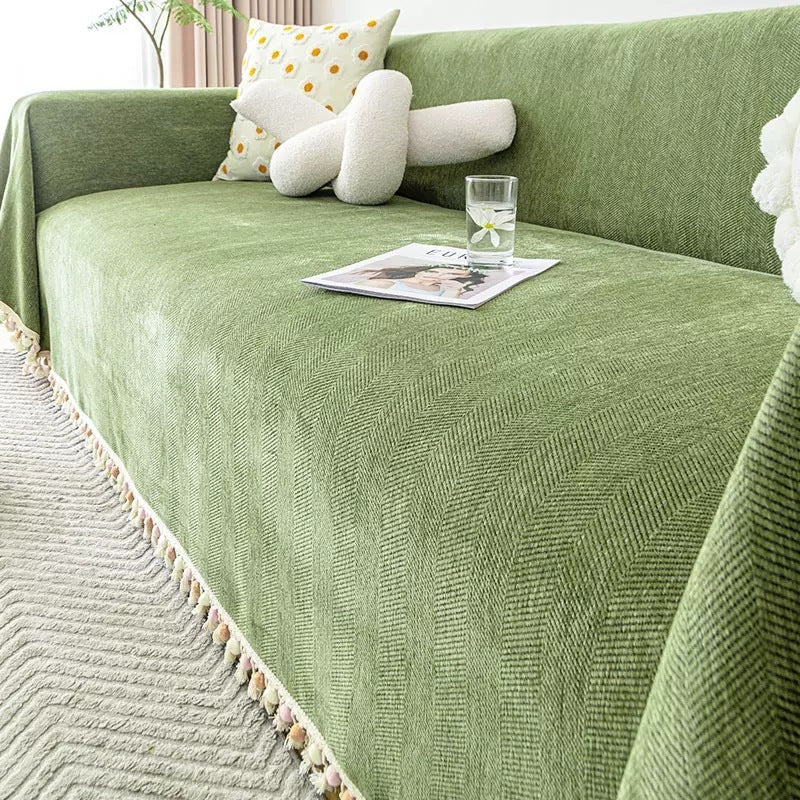
The feature information in this guide comes from the current MaisonSoft Chenille Cover listing. Consult the Sofa Size Guide before selecting individual pieces. The header is an AI-created styling illustration; the product card uses the actual listing photograph.
Disclaimer
This guide provides general information. Materials, dimensions, protection features and care requirements vary by product. Refer to the individual product page for current specifications before purchasing.
Spring Chenille Sofa Cover: Rainforest Secret Colour for a Neutral Australian Lounge
Persian Floral Sofa Slipcover: Patterned Imitation Linen for a Plain Lounge
Continue reading

StriGuard Sofa Towel: Striped Cotton-Blend Coverage with Realistic Pet Protection

Stretchy Nordic Sofa Cover: A Closer Fit for Compatible Australian Sofas

Dual-Sided Geometric Jacquard Sofa Cover: Cotton Chenille with a Graphic Finish

SoftBlend Luxe Sofa Cover: Cotton-Blend Comfort and Gentle Care for Australian Homes

Water-Repellent Sofa Protection: A Practical Guide to the Anti-Scratching Cover

ChenilleEase Slipcover: A Removable Layer for Dust and Everyday Seat Wear
