


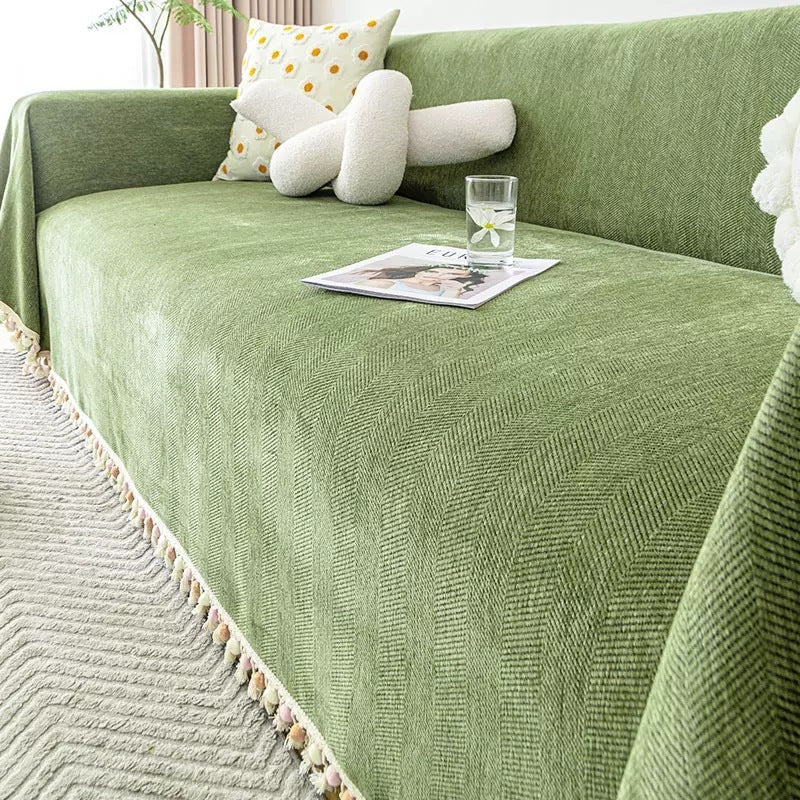


Spring Chenille Sofa Cover: Rainforest Secret Colour for a Neutral Australian Lounge

A plain sofa can be comfortable, structurally sound and still feel out of step with the room around it. Perhaps the walls are warm white, the rug is neutral and the furniture has accumulated gradually rather than arriving as a matching collection. Replacing the lounge to introduce colour is a substantial decision. A patterned cover offers a smaller, more flexible way to change what you see every day.
The Spring Chenille Sofa Cover in Rainforest Secret brings botanical shapes, varied colour and a textured surface to that decision. Its appeal is the broad draped format: the pattern can become a visible feature across a seat, back and arms rather than appearing only on a small scatter cushion. For an Australian apartment, a suburban lounge or a room used by several people, that can make an existing sofa feel more intentional.
However, a beautiful photograph does not answer every buying question. You still need to understand the dimensions, where the fabric will fall, how much upholstery will remain exposed and what maintenance the product requires. This guide considers those practical details alongside the design benefit, so you can decide whether a large patterned chenille cover belongs in your room.
The Spring Chenille cover at a glance
The current product listing describes soft chenille with a three-dimensional texture, good drape and a non-slip backing. Rainforest Secret is the listed colour theme. The design combines botanical elements with other decorative shapes, and the product is presented as suitable for year-round use.
The available size options share a 180 cm dimension, with the other dimension ranging from 90 cm to 480 cm. This is a rectangular draped cover, not a tailored replacement upholstery skin. The packing list states one chenille sofa cover.
In this guide
- The Spring Chenille cover at a glance
- 1. What Rainforest Secret changes in a neutral room
- 2. Decide whether you want a feature or an accent
- 3. Understand the two dimensions before choosing a length
- 4. A measuring method for a continuous drape
- 5. A worked example without a fit guarantee
- 6. What chenille texture contributes to daily comfort
- 7. How to introduce the pattern without buying a whole new room
- 8. Non-slip backing: helpful, with practical limits
- 9. Everyday protection is different from complete protection
- 10. Plan cleaning before the first wash
- 11. Make the purchase work for your budget
- 12. A first-week styling and fit review
- Questions to settle before ordering
- Choose the pattern with a clear coverage plan
1. What Rainforest Secret changes in a neutral room
A large patterned textile changes several visual relationships at once. It can connect a green plant with a softer wall colour, introduce warmer notes beside pale timber and make a plain sofa the room's main point of interest. You do not need every accessory to repeat every colour. In fact, a room often feels more settled when a strong pattern has a little space around it.
Look first at what is already difficult to change. Floorboards, carpet, curtains and the sofa's exposed legs may remain visible after you add the cover. Those surfaces provide the background against which the pattern will sit. A cover that works with one of their undertones is easier to integrate than a choice made from an isolated product thumbnail.
The product photography shows a botanical composition on a light background. Use the live gallery to examine the exact current option rather than assuming all nature-inspired covers have the same palette. A phone screen, warm lamp or brightly edited room image can affect your impression. If a precise colour match matters, ask for further photographs or clarification before ordering.
For a rental home, this kind of change can also be attractive because it does not depend on repainting or attaching anything to the walls. That is a practical decorating benefit, not a claim about a particular tenancy agreement. Your room can gain character through a removable textile while the underlying sofa continues to do its existing job.
2. Decide whether you want a feature or an accent
There are two useful ways to style this cover. The first is to let it occupy most of the visible sofa. The second is to show a smaller section of pattern while leaving some original upholstery exposed. Both can look considered, but they require different measurements and different expectations.
A feature approach suits a very plain room or an older lounge whose colour you no longer enjoy. You might want the cover to extend over the back and arms, creating a broad field of pattern. In that arrangement, the side drops and rear allowance become part of the buying calculation. Measuring only the seat is unlikely to be sufficient.
An accent approach may suit a sofa you still like. You could cover the seating area and allow a measured front drop, using the original back cushions as a calm contrast. The result is more obviously layered. It can also make the cover easier to remove, although movement and exposed areas still need attention.
Before choosing, take a photograph from the doorway. That is often closer to your everyday view than a close-up taken directly in front of the sofa. Sketch where you want the patterned fabric to end. This simple exercise prevents a common mismatch: expecting a full-room transformation from a rectangle selected only to fit a seat cushion.
3. Understand the two dimensions before choosing a length
The size menu currently includes 180 × 90, 130, 150, 180, 200, 230, 260, 280, 300, 320, 340, 360, 380, 400, 420, 440, 460 and 480 cm options. Read each as a rectangle. The repeated 180 cm dimension does not expand merely because you choose a longer second dimension.
A broad throw has to follow the surface of the sofa. One direction might travel from the rear of the backrest, over the top, down to the seat and towards the front edge. The other might travel across the seating area, over the arms and down both sides. Which direction you use depends on the sofa and the way you want the pattern displayed.
Do not automatically treat the longest number as the width of the furniture. Rotate the planned rectangle on your sketch and compare both orientations. A very long option may supply generous side coverage but still be insufficient in the front-to-back direction. Extra length in one direction cannot compensate for a shortage in the other.
If you are uncertain, contact the store with a photograph and measurements. Include the height of the back, seat depth and the path over each arm. A message that simply says “Will this fit my three seater?” leaves too much information missing, because sofas with the same seating label can have very different proportions.
4. A measuring method for a continuous drape
Start with a flexible tape measure and follow the upholstery rather than holding the tape in the air between two points. Measure the route the fabric will actually take. This matters particularly where an arm is rounded, a backrest is thick or the seat has a deep gap.
For the front-to-back route, note the rear drop you want, the journey over the top of the back, the distance down to the seating surface, the seat depth and the front drop. If you intend to tuck fabric into the seat-back gap, include an allowance for that tuck. Do not count the same section twice.
For the side-to-side route, measure over each arm as well as across the seats. An arm that looks narrow from the front may use considerable fabric because the cover must travel up its inner face, across the top and down the outside. The measured path can be noticeably longer than the sofa's straight external width.
Finally, mark a sensible stopping point above the floor. Fabric pooling near a walkway can look untidy and can be pulled when someone passes. If a fringe is present on your selected cover, inspect how the listing represents its edges and ask whether stated dimensions include the fringe when that distinction affects fit.
Record the two completed routes and compare them with the available rectangle. You are looking for enough material to achieve your intended drape without creating an awkward amount of surplus. The store's sofa size guide provides a useful starting point, but your own furniture measurements determine the final choice.
5. A worked example without a fit guarantee
Consider a hypothetical straight sofa with a planned side-to-side fabric route of 270 cm and a front-to-back route of 170 cm. An available 180 × 280 cm rectangle could appear worth investigating because both dimensions exceed those routes. This is a planning example, not a recommendation for a real customer's sofa.
The extra 10 cm in each direction is not automatically enough for every tuck, seam position or adjustment. You would still check whether the route was measured over the upholstery, whether the cover is oriented as intended and whether the margin produces the look you want. A product photograph cannot settle those questions.
Now imagine the same sofa with a taller back that increases the front-to-back route to 205 cm. Choosing a 180 × 340 cm option does not solve that shortage if the 180 cm direction still has to follow the 205 cm route. This is why selecting the largest-looking number can lead to disappointment.
For an L-shaped lounge, a single rectangle may also bridge the corner rather than lying neatly over each section. Separate coverage or a different cover format may be more suitable. Treat modular layouts as several surfaces to assess, and obtain compatibility advice rather than assuming the longest Spring Chenille size will wrap every configuration.
6. What chenille texture contributes to daily comfort
Chenille is valued for its soft textured character. In this product, the stated three-dimensional surface and good drape are part of the appeal: the cover offers more visual depth than a flat printed sheet and can soften the appearance of a plain upholstered lounge.
Texture is also personal. Some people enjoy a plush surface under their hands; others prefer a smoother or lighter fabric. If touch is the main reason for buying, read the product description carefully and ask questions that relate to your preference. An online photograph cannot convey the exact weight, thickness or hand feel.
The listing describes year-round suitability, but that should not be interpreted as active temperature regulation. Indoor comfort depends on the room, the underlying upholstery, clothing and how you use the sofa. A cover is an added textile layer. It does not cool a hot room or provide a verified insulation rating.
For Australian homes that move between open windows, ceiling fans and air conditioning, the useful question is whether you want this texture on the lounge throughout your ordinary routine. You might keep the cover in place all year or change textiles seasonally. Neither approach requires treating “all season” as a technical performance certificate.
7. How to introduce the pattern without buying a whole new room
Begin with the cover and a small number of existing accessories. Place it on the sofa, step back and let your eye adjust before adding more colour. A strong textile can change how the rug and curtains appear; decisions made before installation may no longer be necessary afterwards.
A plain cushion can give the pattern a resting point. Choose a colour already present in the room or one quieter tone from the cover. Avoid assuming the cushions displayed in product images are supplied. The packing list is for one sofa cover, and any additional decorative items should be checked separately.
If your rug is patterned, compare its scale with the cover. Two busy designs of similar scale can compete. You may prefer to expose less of the cover, reduce other patterned accessories or keep a generous area of plain upholstery visible. There is no universal rule, but visual competition is easier to judge from a full-room view.
Timber furniture and simple ceramics can provide a calm setting for botanical shapes. Plants may echo the theme without needing to match the printed leaves exactly. You do not need to create a literal rainforest room; the cover can simply introduce a softer connection between the sofa and the colours around it.
In a small apartment, keep the coffee table and nearby storage visually tidy. The cover already carries much of the decorative detail. Allowing it to be the main feature often produces a more coherent result than buying several new patterned items in the same week.
8. Non-slip backing: helpful, with practical limits
The Spring Chenille product listing includes a non-slip backing. That is useful because a draped cover should stay reasonably positioned during normal use. However, grip depends on the surface beneath, the fit of the rectangle, the distribution of fabric and the movements of the people using the sofa.
A smooth leather lounge, a textured fabric seat and a loose cushion arrangement are different situations. Do not read a non-slip feature as a guarantee that you will never straighten the cover. A person sliding into a deep seat can pull fabric forward even when the backing offers useful resistance.
Install the cover on clean, dry upholstery. Spread it evenly, remove large folds from the sitting area and arrange the drops so that one side is not carrying most of the weight. Follow the supplied instructions if they specify a particular face or orientation for the backing.
After installation, sit in the places people normally use. Stand up, move between seats and inspect the result. If the cover shifts, first reassess the dimensions and distribution. Avoid improvised adhesives or pins that could damage the textile or upholstery. Persistent movement is a compatibility question to raise with the store.
9. Everyday protection is different from complete protection
A removable cover can receive some dust, crumbs and contact that would otherwise reach the sofa's exposed surface. That is a useful household role, particularly on a lounge used for reading, watching television or gathering with family. It also makes the surface easier to access when you remove the cover.
It does not seal the sofa. Gaps, exposed arms and uncovered sides remain vulnerable, and fine debris can still move underneath. Lift the cover periodically and clean the original upholstery according to its own instructions. A cover should make maintenance more manageable rather than become a reason never to inspect the furniture beneath.
There is no verified waterproof specification in the Spring Chenille listing. Drinks, wet clothing and pet accidents therefore require prompt attention. Do not assume the textile will stop liquid reaching upholstery because it is described as a protector or dust cover.
Similarly, chenille is not a promise of resistance to determined clawing. If a pet repeatedly scratches a favourite area, the cover can be an additional layer but may itself snag or become damaged. Choose a product around the actual problem you need to manage, and ask for stronger protection specifications if they are essential.
10. Plan cleaning before the first wash
The current listing describes the material and its styling benefits but does not provide a precise wash temperature, machine setting or drying method. That missing detail matters for a large cover. Before buying, request the care label or written instructions if you expect to wash it routinely.
Do not borrow instructions from another chenille product. Fibre blends, backing materials, trims and finishes can differ. A general statement that chenille is washable does not establish the correct care method for this particular cover, especially where a non-slip backing is involved.
For routine surface maintenance, handle the fabric gently and avoid aggressive brushing that could catch the texture. Keep the original sofa care instructions separate from the cover instructions. A suitable cleaning method for the upholstery underneath may be unsuitable for the removable layer.
If washing is permitted, consider the size of the chosen cover, your machine's stated capacity and the space available for drying. A very large rectangle can be inconvenient in a compact laundry. Plan how it will be fully dried before putting it back on the sofa, rather than assuming every size will fit your usual household routine.
Ask whether the label allows tumble drying or ironing before using either. Do not add treatments, sprays or bleach on the assumption that they will be harmless. The benefit of a removable cover is strongest when its care requirements fit the home you actually have.
11. Make the purchase work for your budget
Compare the total arrangement you want, not just the smallest displayed price. A shorter option may be useful as an accent but insufficient for your intended coverage. Selecting it to reduce the initial cost can leave you buying another piece or accepting an appearance you did not want.
At the same time, the longest available cover is not automatically the best value. Surplus fabric can be harder to manage, wash and store. The right size is the one that serves a clear layout. Keep your measurements and preferred drop lengths beside you while using the size selector.
Check the current product price, availability, delivery information and store policies on the live page. Those details can change. Do not assume a promotional image, an old article or a price seen in a search result reflects the final order you are placing.
If the existing sofa is comfortable and sound, a cover can be a practical decorating purchase. If its cushions have collapsed or its frame needs repair, a textile will not correct those problems. Distinguishing appearance from structural comfort helps you direct your budget towards the improvement that will matter most.
12. A first-week styling and fit review
When the cover arrives, compare the selected size and colour with your order before arranging the room around it. Read the supplied instructions, then try the planned orientation on the sofa. Keep the packaging and order details while you assess the product according to the store's policies.
Look at the pattern in daylight and under your evening lighting. A living room is rarely viewed under one lighting condition. You may discover that a lamp creates a warmer impression or that a particular angle shows more of the light background than you expected.
During the first few ordinary uses, observe where the fabric moves and whether the front drop remains clear of the floor. Make small adjustments to the distribution rather than constantly pulling only the most visible edge. If the size cannot achieve your intended layout, photograph the issue and contact the store.
Finally, resist the urge to add accessories immediately. Live with the pattern for a few days, then decide whether one plain cushion or a different placement of existing furniture is enough. The most useful benefit may be that your familiar lounge now looks coordinated without a larger decorating project.
Questions to settle before ordering
Can one Spring Chenille cover dress an entire sofa?
Potentially, if the chosen rectangle covers your measured fabric routes and the sofa shape is compatible. It is not guaranteed by a two-seater or three-seater label. Decide whether you want seat coverage, a continuous full drape or only a decorative accent, then measure that arrangement.
Is Rainforest Secret available in several different colours?
Rainforest Secret is the listed colour theme for this product. Use the live selector and gallery to confirm the option being sold. Do not assume a differently named cover elsewhere in the store is another colour of the same item.
Is this a fitted stretch slipcover?
The dimensions and product presentation describe a rectangular draped cover. It should not be expected to hug every contour like a tailored or stretch fitted cover. If a close fitted silhouette is your priority, compare a product specifically designed for that purpose.
Can I machine wash it?
A specific machine-washing instruction is not published in the current product details reviewed for this guide. Ask for the care label before purchasing if machine washing is essential. Once supplied, follow the instructions for this exact product and selected option.
Will the cover make my sofa waterproof?
The current listing does not establish a waterproof barrier. Treat spills promptly and inspect the sofa underneath if moisture may have passed through. Choose around verified protection features rather than the general word “cover”.
Will it match the product photo exactly in my room?
The selected product should correspond to its listing, but lighting, screen settings, fabric folds and the visible section of a large pattern can affect appearance. Consult the actual product gallery for purchase decisions; the header illustration shows a possible room styling arrangement.
What is the best next step if I am unsure about size?
Send the store a sofa photograph and both measured fabric routes, including desired drops and any tuck allowance. Explain whether the back and arms need coverage. That gives a much stronger basis for advice than a seating label alone.
Choose the pattern with a clear coverage plan
The Spring Chenille Sofa Cover is most appealing when you want soft texture and a visible botanical pattern on an existing lounge. Its broad size range offers flexibility, but the fixed 180 cm dimension and the way fabric travels over furniture must be understood.
Measure first, decide how much pattern you want to see and confirm care before ordering. Those three decisions turn a decorative impulse into a more useful purchase. The live product page is the place to check current options and select the rectangle that suits your intended arrangement.
Product information and useful reading
This guide uses the current Spring Chenille Sofa Cover listing for product features and options. Use the Sofa Size Guide alongside your own measurements. The header is an AI-created styling illustration based on the product reference; the product card shows the actual listing photograph.
Disclaimer
This guide provides general information. Materials, dimensions, protection features and care requirements vary by product. Refer to the individual product page for current specifications before purchasing.
Chenille Light Luxury Sofa Cover: A Piece-by-Piece Lounge Upgrade for Australian Homes
MaisonSoft Chenille Cover: Building a Coordinated Cover Set for a Modular Lounge
Continue reading

StriGuard Sofa Towel: Striped Cotton-Blend Coverage with Realistic Pet Protection

Stretchy Nordic Sofa Cover: A Closer Fit for Compatible Australian Sofas

Dual-Sided Geometric Jacquard Sofa Cover: Cotton Chenille with a Graphic Finish

SoftBlend Luxe Sofa Cover: Cotton-Blend Comfort and Gentle Care for Australian Homes

Water-Repellent Sofa Protection: A Practical Guide to the Anti-Scratching Cover

ChenilleEase Slipcover: A Removable Layer for Dust and Everyday Seat Wear

Persian Floral Sofa Slipcover: Patterned Imitation Linen for a Plain Lounge
