


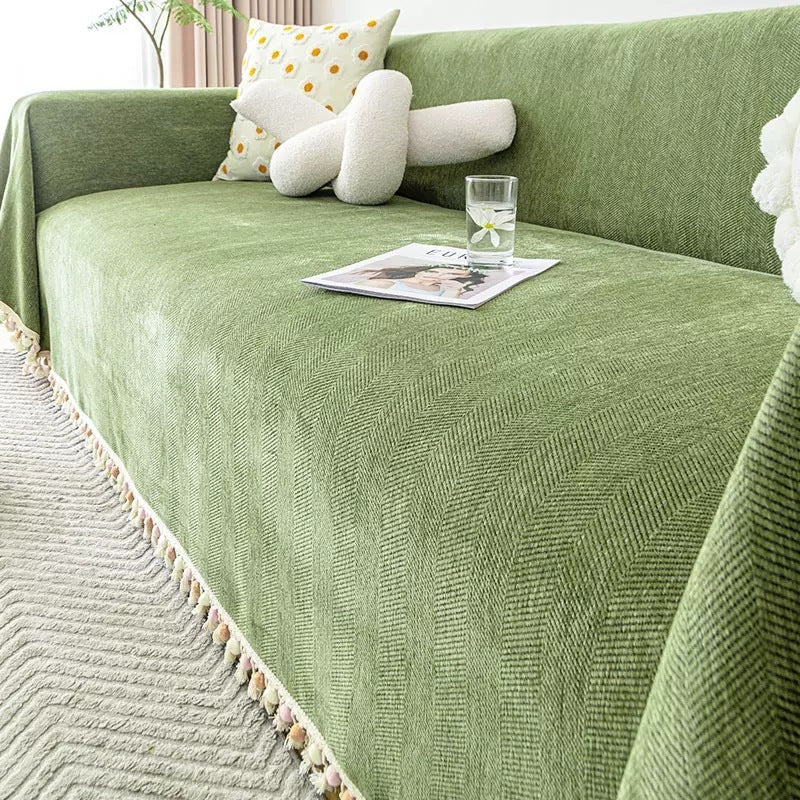


Water-Repellent Sofa Protection: A Practical Guide to the Anti-Scratching Cover

A small spill on the lounge can turn an ordinary evening into a cleaning job. In a busy Australian home, a drink may sit beside the television seat, a child may carry a snack into the living room or a pet may settle on the upholstery after coming indoors. A practical sofa protector can help you manage some of that everyday contact, provided you understand what its protection actually means.
The product sold as the Waterproof Anti-scratching Sofa Cover is currently described on its page as a water-repellent furniture protector. That wording is important. The listed surface is intended to help slow liquid penetration so that small spills can be wiped away promptly. It is not a published guarantee that every spill or pet accident will be contained indefinitely.
The cover also offers removable individual pieces, neutral colour choices and machine-washable maintenance. Its listed role includes protection from pet hair, dust, light scratches and day-to-day wear. Those are useful benefits for a lounge you want to keep comfortable and easy to refresh.
This guide explains how to choose and use the protector with realistic expectations. It focuses on the areas that matter to shoppers: liquid protection, pet contact, individual sizing, care and the total arrangement you will receive. You can then decide whether it addresses the actual problem in your home.
Product facts before the buying decision
The current colours are Beige, Coffee Color and Gray. Individual sizes include 70 × 70, 150, 180 and 210 cm, plus 90 × 90, 160, 180, 210 and 240 cm. A Set 1 option appears in the product choices, but its contents should be confirmed before purchase.
The listing states one sofa-cover piece in the selected colour and size unless a set option is specifically selected. It describes water repellency, a removable protective layer and machine washability. Exact wash settings should come from the supplied care label.
In this guide
- Product facts before the buying decision
- 1. Water repellency can be useful because response time matters
- 2. Understand the terms before comparing covers
- 3. A sensible first response to a small spill
- 4. Decide which everyday risk you want to manage
- 5. Individual pieces let you target the busy areas
- 6. Measure the protective surface and the necessary allowances
- 7. Ask what Set 1 contains before selecting it
- 8. Light scratch protection has a realistic household role
- 9. Hair and dust are easier to manage when the layer is accessible
- 10. Machine washing is a benefit with settings to confirm
- 11. Fit the cover for everyday use, then test the arrangement
- 12. Neutral colour can make protection feel part of the room
- 13. A hypothetical plan for a pet's favourite chaise
- Frequently asked questions
- Choose protection that matches the problem
1. Water repellency can be useful because response time matters
A surface that helps slow liquid penetration can give you a more manageable first response to a small splash. The practical benefit is the opportunity to remove liquid promptly rather than allowing it to sit on exposed upholstery. That can be helpful in a room where drinks and daily life are close to the sofa.
However, the current product information does not provide a tested duration, liquid volume or pressure rating. Do not turn “helps slow penetration” into a claim that a spill can remain safely unattended for a particular number of minutes. The sensible approach is to act as soon as you notice it.
The result can also vary with the type of liquid, where it lands and how the cover is arranged. An edge, gap or uncovered arm may bypass the protective surface entirely. A person sitting on a wet area can change the conditions again.
Choose the cover if that additional surface is useful to your household, while retaining an ordinary spill-response routine. A protector is most helpful when it supports prompt action. It should not encourage leaving drinks unattended on the sofa or postponing checks underneath.
2. Understand the terms before comparing covers
Water repellent describes a surface that resists wetting or helps slow penetration. Waterproof is a stronger term that should be supported by a relevant product specification. In this case, the live description reviewed for the guide establishes water repellency rather than a tested complete liquid barrier.
Stain resistance is another separate concept. A liquid that is removed quickly can still leave a mark on a textile, depending on its contents and the care method. The current description does not establish that every food, cosmetic or drink stain will be prevented or removed.
Scratch protection also needs careful reading. The page describes light scratching and ordinary wear. It does not publish a claw-proof rating or guarantee against a pet repeatedly digging or pulling at the fabric.
When comparing products, make a short list of the verified features you actually need. If complete liquid containment is essential, ask the store whether a suitable tested specification is available. If the main issue is hair and occasional splashes, a removable water-repellent layer may be a more relevant category to assess.
3. A sensible first response to a small spill
Keep the sofa's own care instructions accessible. If a spill occurs on the cover, remove excess liquid gently and promptly using a method compatible with the cover's care guidance. Avoid rubbing a wet area aggressively, which can spread the spill or work it into a textile.
Check whether liquid has reached an edge or passed underneath. Lift the affected piece carefully so that collected moisture is not transferred onto another part of the sofa. Inspect the original upholstery rather than judging the result only from the upper surface.
If the furniture beneath needs cleaning, use its own approved method. A care instruction for the removable protector does not automatically apply to leather, velvet or another upholstery material. Treat the two surfaces as separate items with separate requirements.
Do not return a damp piece to the lounge. Clean it as instructed and allow it to become fully dry by the permitted method. If the stain or cleaning method is uncertain, seek guidance before applying a stronger household chemical.
The benefit of a removable piece is that you can separate the affected layer from the sofa. That does not guarantee the upholstery has remained untouched, but it gives you access to assess the situation and deal with each surface appropriately.
4. Decide which everyday risk you want to manage
Different households need different coverage. A family concerned about occasional drink splashes may prioritise the main seat. A pet owner dealing with loose hair may want a piece on the animal's favourite resting area. Someone concerned about arm wear may need a separate arm rectangle.
Write down the main reason for buying before you choose a size. “I want a removable surface on the chaise where the dog rests” is a clearer goal than “I need protection everywhere”. It tells you which measurements, care questions and quantities matter most.
If repeated major liquid accidents are the concern, do not rely on this guide's description of small-spill assistance. Ask for a product that meets the level of containment you require. A water-repellent layer without a verified waterproof specification may not meet that need.
Likewise, if a pet persistently claws one arm, the cover is only part of the decision. The textile may receive damage itself. The product should be selected around its published features rather than the hope that a protective name will solve a behaviour or wear problem completely.
5. Individual pieces let you target the busy areas
This protector is offered in rectangles you can combine across seats, backrests and arms. That can be useful on a modular lounge where different sections have different dimensions. It can also avoid buying a whole fitted cover when you want to manage only one surface.
The flexibility comes with a responsibility to count pieces. One selected individual size does not supply a complete photographed arrangement. If your plan includes a main seat, a chaise and two arms, those areas need their own considered selections and quantities.
Separate pieces may also make handling more manageable. You can remove the affected section without necessarily taking every cover off the sofa. Think about that practical benefit when choosing between one long seat rectangle and several shorter ones.
At the same time, edges between pieces create limits to coverage. A spill can land in a gap or travel beyond a rectangle. The layout should support your main goal, but it should not be described as a sealed protective system around the entire lounge.
6. Measure the protective surface and the necessary allowances
For each seat piece, measure the seating span and the route from the back gap to the front edge. Add the drop and any tuck allowed by the product instructions. Those allowances affect how stable and complete the arrangement feels during use.
For an arm, follow the inner side, top and desired outside drop. Do not choose an arm piece from the top width alone. A backrest also needs a route measurement if the cover is expected to travel over the top and down its face.
The 70 cm family currently includes 70, 150, 180 and 210 cm lengths. The 90 cm family includes 90, 160, 180, 210 and 240 cm lengths. Compare those actual rectangles with the surfaces you measured. A sofa's seating label is not enough to identify a fit.
If one direction is insufficient, a longer option in the other direction does not fix it. Draw the rectangle on your plan and check both dimensions. Where your lounge shape is unusual or a measurement is close to an available boundary, contact the store with photographs.
Keep the cover clear of reclining mechanisms and floor-level walkways. Flexible piece coverage is useful on many layouts, but it does not automatically establish compatibility with every moving sofa component.
7. Ask what Set 1 contains before selecting it
A named set option can be convenient if its actual contents match your plan. However, a label such as Set 1 does not explain the number, dimensions or intended placement of the pieces. Do not infer those details from a styled image.
Request a clear list of what is supplied with that option. It should identify how many pieces arrive and the size of each. Compare that list against your sofa measurements before deciding whether it is more suitable than selecting individual rectangles.
Also check whether the set option has a different price, colour availability or delivery information. The order should be assessed as a specific collection of items, not as a shortcut around measuring. A pre-arranged combination can still be unsuitable for a particular chaise or arm.
If the store cannot confirm the contents clearly, choose only options whose dimensions and quantities you understand. That keeps the purchase concrete and prevents a mismatch between the expected full-sofa result and the actual package.
8. Light scratch protection has a realistic household role
An extra textile layer can take some ordinary contact from a pet's movement and resting. It can also collect loose hair on a surface you can lift away. Those are useful reasons to consider a protector on a favourite pet spot.
They do not establish resistance to determined clawing. A cat repeatedly scratching an arm, a dog digging at its bed space or a pet catching an edge can damage fabric. Light scratch protection should not be presented as an indestructible barrier.
Observe where the pet actually makes contact. If it rests on the seat but scratches the outside arm, covering only the seat does not address the second area. The distinction between covered and uncovered surfaces is as important as the feature list.
Check the textile regularly for pulls or damaged edges and inspect the upholstery beneath. Avoid using the cover as evidence that the sofa can be left unmonitored indefinitely. Its practical value is an accessible additional layer, not a guarantee that all pet wear disappears.
If you need stronger protection, ask for the relevant specification and compare suitable products. Do not rely on staged photographs of an animal near a sofa as proof of tested scratch performance.
9. Hair and dust are easier to manage when the layer is accessible
A removable piece can give hair and dust an accessible surface. You can lift it to inspect the sofa below and follow the cover's approved cleaning method. This may be useful when the original upholstery is difficult to clean in place.
Some debris can still settle underneath or enter cushion gaps. Include those areas in routine maintenance rather than treating the cover as a reason never to lift the cushions. The original sofa still needs care according to its own instructions.
Handle the cover gently during removal so loose material is not simply scattered around the room. Choose cleaning tools and methods compatible with the textile and its backing. Aggressive brushing or improvised treatments can introduce a new problem.
Consider the selected colour in relation to common household fibres. Beige, Coffee Color and Gray offer different visual contrasts, but none is automatically the best for every pet coat or type of debris. A colour choice can affect visibility; it does not change the need to clean.
10. Machine washing is a benefit with settings to confirm
The current page lists the protector as machine washable. That makes routine care a relevant part of the buying decision, particularly when individual pieces can be handled separately. However, the exact permitted temperature, cycle and drying instructions need to be checked on the supplied label.
Do not assume that hotter water means better protection or that a high-heat dryer will be harmless. Fabric surfaces, backing and finishes can require specific care. Follow the instructions for this exact product rather than advice for another sofa protector.
Before washing, consider the size of the piece and the machine's stated capacity. A long seat rectangle may need a different load arrangement from a small arm piece. Avoid overcrowding, and follow any directions about detergents or other products.
Dry the cover fully by the approved method before fitting it again. Check the underside as well as the visible face. Inspect the surface and backing after cleaning, and ask the store whether any particular care is necessary to maintain its stated water-repellent feature.
Do not add a waterproofing spray or other treatment without product-specific approval. A stronger-sounding chemical is not automatically compatible with the cover or with upholstery beneath it. Clear care instructions are part of the product's practical suitability.
11. Fit the cover for everyday use, then test the arrangement
Start with the sofa clean and dry. Spread the pieces across their planned surfaces and balance the fabric so that one edge is not pulling the rest out of position. Follow supplied installation instructions rather than treating every rectangle as interchangeable.
The product description presents it as a flexible furniture protector, but that does not guarantee a motionless fit. Upholstery material, cushion shape and sitting movements affect how a loose piece behaves. Expect to assess the arrangement in normal use.
Sit in the main seats, lean on the arms and stand up. Check whether a critical area becomes exposed after those movements. If so, reconsider the dimensions or placement. A protective layer that moves away from the surface you care about is not meeting the intended goal.
Do not use pins, glue or unsupported attachments to force it into place. If the product is not compatible with your sofa finish or shape, seek advice. Good coverage begins with a suitable plan and product, not with altering the furniture to accommodate a guess.
12. Neutral colour can make protection feel part of the room
A protector does not need to look like a temporary household workaround. A deliberate colour relationship can help it belong in the lounge, especially when the sofa is prominent in an open-plan living and dining area.
Beige may create a softer contrast with warm walls and timber. Coffee Color can connect with deeper neutral furnishings. Gray may suit a cooler scheme. Check the actual current photographs because those names do not establish a precise undertone.
Choose whether you want the pieces to blend with the sofa or stand apart as a visible layer. If only the seat and arms are covered, the original back cushions remain part of the colour scheme. Compare both surfaces together.
Keep styling simple if practical protection is the main reason for buying. Existing plain cushions and a tidy side table may be enough. Decorative accessories in product photographs should not be counted as included items unless the order specifically identifies them.
13. A hypothetical plan for a pet's favourite chaise
Imagine a household whose dog usually rests on the chaise. The main goal is an accessible layer for hair and occasional light contact, with some help managing a small splash. The household measures that surface rather than purchasing a whole set immediately.
It checks the chaise length, depth, front drop and any tuck allowance. It confirms whether an available 70 cm or 90 cm rectangle suits both directions, and it reviews the washing instructions and drying space. It does not assume the longest available length will solve an insufficient width.
The household also recognises the boundaries: uncovered sofa sections remain exposed, and the selected piece is not a verified liquid-containment mat or claw-proof surface. It plans to inspect and clean the upholstery underneath when needed.
This example is a decision method, not a customer result or size recommendation. Your main concern may require several pieces or a different product specification. Keeping the goal precise helps you judge the cover's practical benefit honestly.
Frequently asked questions
Why does this guide say water repellent when the product name says waterproof?
The current product description specifies a water-repellent surface that helps slow liquid penetration. This guide follows that published detail rather than expanding the name into an unsupported complete-waterproofing guarantee.
Can it contain a pet accident all night?
No such duration or containment guarantee is supplied in the details reviewed here. Respond promptly, check the upholstery beneath and choose a product with a suitable verified specification if prolonged liquid containment is essential.
Is the cover safe from a cat repeatedly scratching it?
The listing describes light scratch protection, not an indestructible or claw-proof fabric. Repeated scratching can damage textiles. Assess the actual contact and request stronger specifications if needed.
Does one piece cover a complete lounge?
Not automatically. Individual sizes correspond to one rectangle. Measure each area and count the needed pieces. Confirm the contents of any named set option separately.
Can I machine wash it after every spill?
The listing states machine washability, but the label determines the permitted method. Follow those instructions and assess whether cleaning is required. Do not assume unlimited high-heat washing or tumble drying is allowed.
What should I confirm about Set 1?
Ask for the exact number and dimensions of the supplied pieces, plus current colour and price information. Compare those contents with your measured surfaces before ordering.
Will the cover protect exposed gaps between pieces?
A piece protects only the surfaces it actually covers. Gaps and exposed upholstery remain accessible to liquid, dust and contact. Plan the layout carefully and keep expectations tied to that physical coverage.
Choose protection that matches the problem
This water-repellent protector is worth considering for removable piece coverage, assistance with prompt handling of small spills, light everyday contact and machine-washable maintenance. Its strongest practical benefit is helping you manage a busy lounge with an accessible outer layer.
Measure the surfaces, confirm the care and set details, and keep the protection limits clear. The live product page lets you select the current colour and size options for the arrangement you actually need.
Product reference and fit guidance
This guide uses the current description of the Waterproof Anti-scratching Sofa Cover, which specifies water repellency. Use the Sofa Size Guide before choosing pieces. The header is an AI-created styling illustration, not a spill or scratch test; the card uses the actual product image.
Disclaimer
This guide provides general information. Materials, dimensions, protection features and care requirements vary by product. Refer to the individual product page for current specifications before purchasing.
ChenilleEase Slipcover: A Removable Layer for Dust and Everyday Seat Wear
SoftBlend Luxe Sofa Cover: Cotton-Blend Comfort and Gentle Care for Australian Homes
Continue reading

StriGuard Sofa Towel: Striped Cotton-Blend Coverage with Realistic Pet Protection

Stretchy Nordic Sofa Cover: A Closer Fit for Compatible Australian Sofas

Dual-Sided Geometric Jacquard Sofa Cover: Cotton Chenille with a Graphic Finish

SoftBlend Luxe Sofa Cover: Cotton-Blend Comfort and Gentle Care for Australian Homes

ChenilleEase Slipcover: A Removable Layer for Dust and Everyday Seat Wear

Persian Floral Sofa Slipcover: Patterned Imitation Linen for a Plain Lounge
