




Persian Floral Sofa Slipcover: Patterned Imitation Linen for a Plain Lounge

A patterned sofa cover can do more than conceal a tired colour. It can give a plain lounge a different visual character: softer, more detailed and more connected to the other objects in the room. The Persian Floral Collection is an option for shoppers who want that decorative change without committing to a new sofa.
The Ethnic Light Luxury Dustproof Sofa Slipcover in this collection is described as imitation linen, with Persian-inspired floral styling, slip-resistant properties and machine-washable care. It is a broad rectangular cover, available in several lengths, that you arrange over the furniture. Its appeal lies in the relationship between the pattern, the drape and the original sofa shape.
For an Australian living room with timber furniture, neutral walls or a mixture of old and new pieces, that can be an appealing way to make the lounge feel more considered. It can also introduce detail into a rental or apartment where the larger surfaces are already fixed.
The important questions are practical as well as decorative. Is the material actually linen? Will a single rectangle cover the route you intend? How will the design look beside a patterned rug? And what does “dustproof” reasonably mean for an open, removable textile? This guide answers those questions before you choose your option.
What the current product page tells you
The material is listed as imitation linen. The options are named Branches And Tendrils, Huacheng and Knight. The current size range uses a 180 cm dimension with lengths of 130, 180, 230, 260, 300, 340, 380 and 420 cm.
The product page lists slip-resistant properties and machine washability. Its package description states one sofa cover. The selected pattern and rectangle are the product you are buying; decorative objects in room photographs should not be assumed to be included.
In this guide
- What the current product page tells you
- 1. Why a detailed pattern can suit an otherwise simple lounge
- 2. Imitation linen: choose the stated material, not an assumption
- 3. Choose the pattern from the gallery before choosing the size
- 4. Balance the cover with your rug, curtains and artwork
- 5. Understand the rectangle as a fabric route
- 6. Full drape, partial drape or a decorative seat layer?
- 7. A practical sizing example
- 8. Make the drape look deliberate
- 9. Slip resistance is an aid, not a permanent fastening
- 10. What dust coverage does and does not mean
- 11. Machine washing: confirm the settings that matter
- 12. Choose for the household, not only the room photograph
- 13. Compare the complete purchase before checkout
- Frequently asked questions
- Bring the pattern home with the right expectations
1. Why a detailed pattern can suit an otherwise simple lounge
A plain sofa provides a large uninterrupted surface. Adding a floral pattern breaks up that surface and gives the eye several details to follow. The result can feel warmer or more layered, particularly where the rest of the room relies on simple shapes and quiet colours.
This does not mean the room must adopt a traditional theme. A patterned textile can work with a straightforward contemporary sofa and a modern side table. The connection often comes from colour and proportion rather than matching historical styles. Let the cover contribute one decorative element instead of expecting it to dictate every object around it.
Look at your lounge from the place where you usually enter the room. A pattern that appears delicate in a close-up can read more strongly across the entire sofa. Conversely, a subtle design may give texture and detail without becoming the main feature. The live product gallery is useful for assessing that larger view.
The collection name describes a design direction. It does not establish where the product was manufactured or imply that it is an antique, handwoven or culturally authenticated textile. If provenance matters to your purchase, request the relevant product information rather than interpreting a style name as a manufacturing statement.
2. Imitation linen: choose the stated material, not an assumption
Linen-like appearance and linen fibre are different things. The listing for this product uses imitation linen, which describes the offered material or finish without providing a full fibre breakdown. It would therefore be misleading to treat the cover as verified 100% linen.
That distinction matters because shoppers may associate linen with specific washing, creasing or temperature characteristics. Those expectations should not be transferred automatically to an imitation-linen product. Follow the information supplied for this exact cover rather than advice written for a different textile.
You can still choose a linen-like surface for visual reasons. It may provide a woven-looking backdrop for the floral design and contrast attractively with smoother upholstery. The product photographs help you assess that appearance, while questions to the store can clarify the precise feel and composition.
If you are comparing several covers, record the material description exactly as listed. Do not simplify every natural-looking surface into “linen” or every soft surface into “cotton”. Accurate comparisons make it easier to choose according to your priorities, whether those are appearance, texture or a confirmed fibre content.
3. Choose the pattern from the gallery before choosing the size
The option names Branches And Tendrils, Huacheng and Knight are not a substitute for seeing the actual variants. View the current photographs associated with each option and confirm that the selector corresponds to the design you want. Names alone do not tell you the scale, background colour or contrast.
Ask which parts of the design will be visible in your planned arrangement. A full drape over the back and arms displays much more of the pattern than a seat-only placement. Folds can also interrupt a motif. If a particular portion of the design is important, consider whether your sofa layout allows it to show.
A large repeat may create a bold feature, while a quieter design can be easier to combine with existing accessories. Compare the cover beside your room photograph rather than reviewing it only on a white product-page background. That gives you a better basis for judging its visual weight.
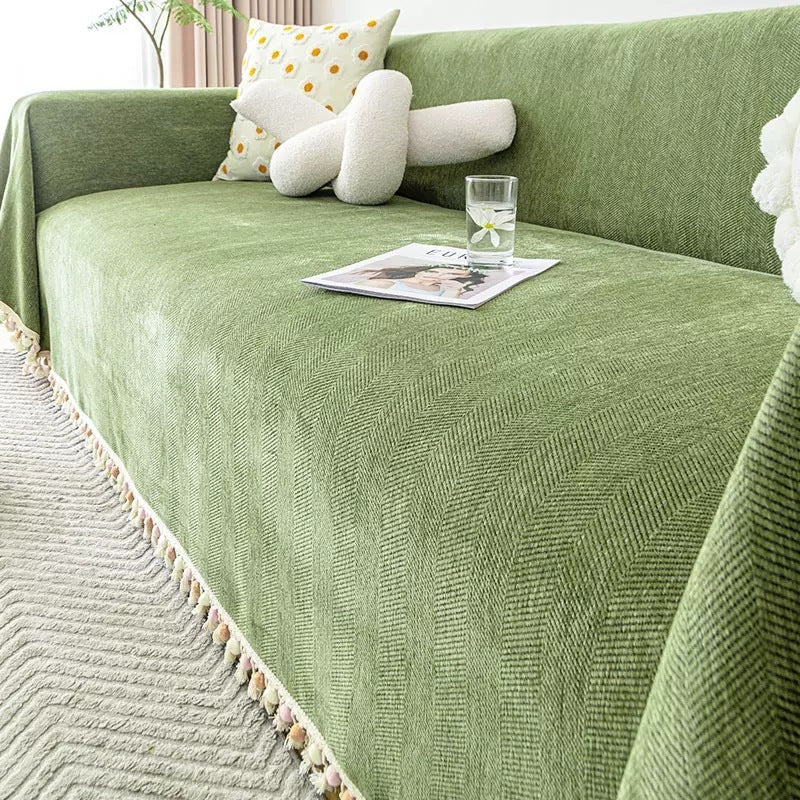
When colour accuracy matters, use the actual gallery and ask for clarification if necessary. Screen settings and room lighting can influence appearance. The article header is a styling illustration based on the product reference; it should help you imagine a room, while the live listing remains the purchase reference.
4. Balance the cover with your rug, curtains and artwork
Start with the room's busiest existing surface. If the rug already has a strong design, you may want the sofa cover to be the only other significant pattern. Plain curtains and cushions can provide some visual breathing space around the two.
If the rug is simple, the cover can take a larger decorative role. You might repeat one quiet colour through an existing cushion or lamp shade. Exact matching is unnecessary; a related tone can connect the objects without making the room look assembled from one catalogue.
Artwork is another consideration. A highly detailed picture immediately above the sofa can compete with a detailed cover, particularly if both have similar contrast. Moving the artwork, reducing nearby accessories or showing less of the cover are possible styling adjustments before you buy anything else.
For an Australian home furnished over time, mixing pieces is normal and can be visually appealing. The useful principle is to choose one or two relationships deliberately: perhaps warm timber with a warm background, or a floral detail that picks up a subdued colour in the rug. A cover does not need to match every item to belong.
5. Understand the rectangle as a fabric route
This collection's size options are rectangles, not furniture-model guarantees. A 180 × 260 cm cover has those two dimensions of textile. It does not certify coverage for every two seater, and a 180 × 340 cm option is not automatically a fitted three-seater cover.
Fabric must travel over the sofa's surfaces. In one direction it may go from behind the backrest, across the top, down the front, along the seat and towards the floor. In the other it may go across the seating span and over both arms. Those routes are longer than simple straight-line measurements.
Choose the orientation that supports your intended coverage and pattern display. The repeated 180 cm dimension is fixed across the listed options. Increasing the other dimension does not provide additional fabric in the 180 cm direction. A tall-backed or very deep sofa may therefore need a different arrangement even when a long option is available.
Measure the actual route with a flexible tape. Write down whether you included a rear drop, arm drops and any fabric tucked into the seat-back gap. This makes the comparison with the product menu concrete rather than dependent on a familiar but imprecise seating label.
6. Full drape, partial drape or a decorative seat layer?
A full drape can cover more of the original colour and show the pattern as a continuous feature. It requires enough fabric in both directions, and the drops must remain practical for walking around the lounge. It may also involve more adjustment after people sit down.
A partial drape can leave the original back cushions or outside arms visible. That creates a layered appearance and may suit a sofa whose upholstery still complements the room. Because less fabric is needed for your chosen route, different size options may become relevant.
A decorative seat layer is a more restrained use. It can provide a new surface where people sit while leaving the sofa's shape clearly visible. However, it does not deliver the same coverage as the broad arrangement shown in some room photographs.
Decide which of these results you actually want before selecting a rectangle. If your priority is hiding a disliked sofa colour, a small seat layer may not satisfy you. If your priority is a touch of pattern, a large drape could feel more dominant than intended.
7. A practical sizing example
Suppose a hypothetical sofa arrangement requires 175 cm of fabric along the front-to-back route and 315 cm over the side-to-side route. A 180 × 340 cm option could be worth checking against that plan. The apparent surplus provides a starting point for considering the edges, not a guarantee of fit.
You would still inspect the accuracy of the measurements, whether the pattern orientation is acceptable and whether the extra length falls where you want it. If the sofa's arms are more rounded than you allowed for, the route can change. Small measurement errors matter when the available margin is limited.
Now consider a chaise or high back requiring 200 cm in the direction you planned to use as 180 cm. A longer second dimension cannot correct that problem in the same orientation. You might rotate the cover, revise the coverage goal or choose another format, but you should not ignore the shortage.
For a corner sofa, the fabric may also bridge the inner corner or gather where two seating directions meet. Ask for compatibility advice with a photograph rather than assuming a broad throw behaves like several fitted pieces. The example here illustrates the calculation only; it does not recommend a particular size for your furniture.
8. Make the drape look deliberate
Once you have the right rectangle, distribute the fabric before focusing on the front edge. Position the main pattern across the area you want to feature, then balance the sides. Pulling one edge repeatedly can leave the opposite side short and make the design appear crooked.
Allow a measured amount of softness in the folds. A draped cover is meant to follow the furniture rather than reproduce a tailored upholstery skin. Trying to make every surface perfectly taut can create tension elsewhere or use up the fabric needed for coverage.
Check how the cover looks around the arm shape. A broad rounded arm may produce a different fold from a narrow square one. Small differences can be acceptable if the overall arrangement is balanced. If you want an extremely close silhouette, compare a fitted product before ordering this rectangular format.
Keep the cover above the floor in areas where people walk. A long hanging edge may be pulled by a foot or vacuum cleaner. Where fringes or decorative edges are visible, inspect the product gallery and supplied instructions so their placement supports the room's use.
9. Slip resistance is an aid, not a permanent fastening
The product page describes slip-resistant properties. That feature can help a draped cover feel more manageable during ordinary sitting, but it does not turn the textile into an attached upholstery layer. Movement remains possible.
The surface beneath matters. Smooth upholstery, loose cushions and deep gaps can all affect how the cover lies. Uneven fabric distribution may also encourage movement because a heavy drop on one side can pull the rest of the rectangle out of position.
Install it on a clean, dry sofa and follow any instructions about which face belongs against the upholstery. Test the arrangement by sitting and standing in your normal places. Judge the result after use, not only when the fabric has just been smoothed for a photograph.
Avoid improvising with glue, adhesive sprays or pins. If the cover will not remain usefully positioned despite an appropriate size and balanced drape, contact the store about compatibility. It is better to identify a genuine fit limitation than to risk damaging the sofa while trying to force the arrangement.
10. What dust coverage does and does not mean
The word dustproof in the product name should be read alongside the physical format. This is a removable cover laid over selected surfaces. It can intercept some settled dust and ordinary contact on those surfaces, but it does not create an airtight enclosure around the sofa.
Dust can still reach exposed sides, gaps and areas under the cover. Lift the textile periodically and inspect the original upholstery. Maintaining both layers is more useful than assuming the presence of a cover eliminates the need to clean the furniture.
The listing also describes protection from everyday wear. A textile layer can receive some friction from normal use, but it is not a published abrasion test result or a guaranteed extension of the sofa's lifespan. How long either surface remains in good condition depends on use and care.
No verified waterproof or determined-claw protection specification is provided for this collection. Blot spills promptly according to the relevant care guidance and check beneath if moisture may have passed through. A decorative cover is most useful when its protective role is understood realistically.
11. Machine washing: confirm the settings that matter
The current product page says the cover is machine washable. That removes one uncertainty about its general care category, but it does not supply every setting. Read the delivered care label for temperature, cycle, detergent, spin and drying instructions before the first wash.
Do not assume that a machine-washable imitation-linen cover can be treated exactly like bed linen or a cotton towel. Different fibres, decorative finishes and backing features can require different methods. The label for this product is the relevant instruction.
The larger rectangle options also deserve a laundry-space check. Consider the machine's stated capacity and whether the cover can move freely in the approved wash. A large item crammed into a small load space may be difficult to clean and rinse properly.
Plan a drying area that lets the cover become completely dry before it returns to the sofa. Follow the approved method rather than adding high heat to speed things up. If the label does not clearly address tumble drying or ironing, ask instead of making a guess.
Keep drinks, cosmetic products and other potential marks in mind when choosing the pattern. A detailed design may make some visual changes less obvious, but that is not stain resistance. The practical benefit is having a removable layer that can be cared for as instructed.
12. Choose for the household, not only the room photograph
Think about who will arrange and remove the cover. A large continuous rectangle may be straightforward for one household and inconvenient for another. If frequent adjustment feels like a burden, consider whether a different format would better suit your daily routine.
Also consider shared use. Children, visiting family or housemates may not return the cover to its original position after sitting. A relaxed draped appearance can accommodate that more easily than an expectation of constant perfection. Decide how tidy you need the lounge to remain without intervention.
For a household with pets, watch for loose claws catching a textured surface or fringe. The product does not provide a claw-proof guarantee. Keep protective expectations separate from the attractive floral styling, and ask about suitability where a pet repeatedly scratches furniture.
If the cover is intended primarily for a quieter sitting room, its decorative contribution may be the main reason to buy. If it is for the busiest lounge in the home, easy removal and compatible care may carry more weight. Both are valid priorities, but they can lead to different choices.
13. Compare the complete purchase before checkout
Check the current live price for the actual size and pattern you intend to order. A smaller variant's price does not represent every rectangle in the range. Delivery details, availability and current policies should also be reviewed on the store's own pages.
Confirm the quantity. The package description is one sofa cover, so a second sofa or chair needs its own considered purchase. Do not assume a room photograph includes multiple pieces in one package or that a cushion shown against the cover comes automatically.
If the cover is intended to conceal a particular area, compare its required dimensions with the selected option one final time. Keep a written note of those measurements. That makes any later sizing question easier to explain and reduces the chance of selecting the adjacent menu option accidentally.
A good-value purchase is one that provides the appearance and coverage you wanted at a total cost you are comfortable with. The most ornate pattern or largest size is not inherently the best choice. Practical suitability gives the decorative benefit somewhere to work.
Frequently asked questions
Is the Persian Floral cover made from pure linen?
The current material description is imitation linen. It should not be presented as confirmed pure flax linen. Ask for a full fibre specification if the exact composition is important to you.
How do I know which named pattern to choose?
Use the live product gallery and selector together. The option names do not describe every visual detail. Confirm the image associated with your selection, especially if you need a particular background colour or pattern scale.
Is one cover enough for a three-seater lounge?
That depends on the sofa's measured fabric routes and your coverage goal. The seater label alone is insufficient. Measure the back, seat and arms along the paths the rectangle will follow.
Does machine washable mean I can use my usual hot wash?
No. The current page establishes machine washability, while the supplied label should determine the permitted settings. Do not assume high temperatures or tumble drying are allowed.
Will a floral pattern hide every mark?
No pattern can be relied on to conceal every mark, and visual camouflage is not stain protection. Choose the appearance you like, clean promptly as instructed and inspect the upholstery underneath when needed.
Can it be used on an L-shaped sofa?
A broad rectangle may not lie neatly through an inner corner. Check the individual sections and ask for compatibility advice. A different piece arrangement or cover format may be more suitable.
Does the design name indicate Persian manufacture?
A Persian-inspired design description does not establish manufacturing origin or heritage certification. Request provenance information if that is part of your buying criteria.
Bring the pattern home with the right expectations
The Persian Floral Collection is an option for a shopper who wants a detailed woven-looking surface and a flexible draped format. Its listed slip resistance and machine washability add practical considerations to the decorative appeal.
Choose the actual pattern from the gallery, measure both fabric routes and confirm the care settings. Those steps help you enjoy the visual change without confusing a style name, material description or room photograph with specifications the product has not provided.
Product reference and sizing
Product features and options are drawn from the current Persian Floral Collection listing. Use the Sofa Size Guide when planning your drape. The header is an AI-created styling illustration, and the buying card uses the actual product photograph.
Disclaimer
This guide provides general information. Materials, dimensions, protection features and care requirements vary by product. Refer to the individual product page for current specifications before purchasing.
MaisonSoft Chenille Cover: Building a Coordinated Cover Set for a Modular Lounge
ChenilleEase Slipcover: A Removable Layer for Dust and Everyday Seat Wear
Continue reading

StriGuard Sofa Towel: Striped Cotton-Blend Coverage with Realistic Pet Protection

Stretchy Nordic Sofa Cover: A Closer Fit for Compatible Australian Sofas

Dual-Sided Geometric Jacquard Sofa Cover: Cotton Chenille with a Graphic Finish

SoftBlend Luxe Sofa Cover: Cotton-Blend Comfort and Gentle Care for Australian Homes

Water-Repellent Sofa Protection: A Practical Guide to the Anti-Scratching Cover

ChenilleEase Slipcover: A Removable Layer for Dust and Everyday Seat Wear
