


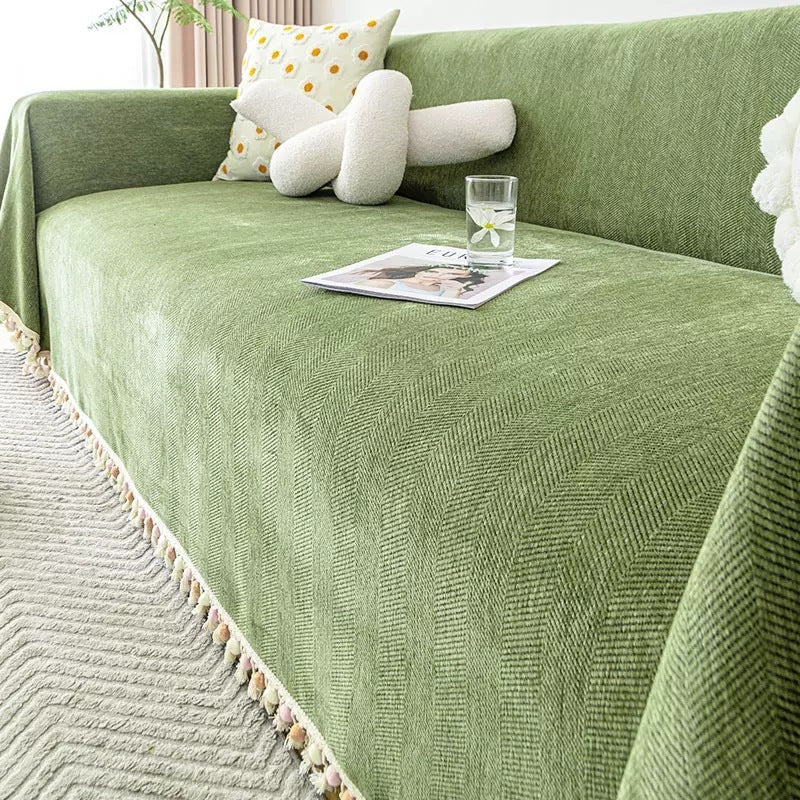


Stretchy Nordic Sofa Cover: A Closer Fit for Compatible Australian Sofas

A loose sofa throw and a fitted stretch cover create different results. A throw adds a visible layer of fabric; a stretch cover is intended to sit more closely around a compatible sofa shape. If your main aim is to change the sofa's overall appearance while keeping a more defined outline, that distinction matters.
The Stretchy Nordic-Style All-Season Sofa Cover is a polyester cover offered in patterned options and three seating-size categories. Its current page provides width ranges for two-, three- and four-seater sofas and describes a flexible stretch fit. That gives Australian shoppers a practical starting point for assessing a familiar straight lounge.
The appeal is a closer silhouette, a modern patterned finish and an additional surface for ordinary daily use. It may be useful when your sofa remains comfortable but its colour no longer suits the room, or when you prefer fewer draped edges than a loose rectangle would create.
The important word is compatible. Stretch does not mean unlimited size, and a seating category is not a guarantee for every arm, cushion or mechanism. This guide explains the listed ranges, the shape questions, the pattern decision and what to confirm before ordering, so you can choose the cover for the result it is designed to offer.
The current Nordic cover facts
The material is listed as polyester. The cover is described as a flexible stretch design for common two-, three- and four-seater sofas. Current pattern names include Magic Cube, Morica, Peninsula and Rubik's Cube; check the actual gallery and selector for their appearance.
The listed width ranges are:
- Two seater: approximately 110–160 cm.
- Three seater: approximately 160–195 cm.
- Four seater: approximately 195–230 cm.
The packing description states one sofa cover in the selected pattern and size. The current information reviewed here does not publish a precise washing temperature or machine programme.
In this guide
- The current Nordic cover facts
- 1. What a closer fitted appearance can change
- 2. Measure full width, including the arms
- 3. Read the width ranges as approximate guidance
- 4. Assess shape before you commit
- 5. Polyester stretch construction and everyday feel
- 6. Pick the pattern for the full sofa
- 7. Keep the rest of a small room deliberate
- 8. Prepare the sofa before installation
- 9. Evaluate the fit through ordinary sitting
- 10. Daily protection is an added surface, not a complete barrier
- 11. Resolve care instructions before purchase
- 12. Compare fitted and draped formats fairly
- 13. A hypothetical decision for a 175 cm straight sofa
- Frequently asked questions
- Choose the fitted result with compatibility first
1. What a closer fitted appearance can change
A fitted cover can make the sofa's surfaces read as a more continuous whole. Instead of seeing separate draped rectangles, you see a textile following the main furniture outline. That can be appealing when you want the existing lounge to look more visually unified.
The pattern also has a larger role than it would on a small cushion. It can appear across the seat, back and arms, changing how the sofa relates to the rest of the room. Choose it as a room-level decision rather than an isolated decorative detail.
A closer silhouette may suit a small Australian apartment where the sofa is prominent and there is limited space for loose hanging fabric. However, compatibility remains essential. A cover that is too small, too loose or mismatched to the arm shape will not produce the intended result simply because it stretches.
The benefit is a new outer appearance on compatible furniture. It is not equivalent to professionally reupholstering the sofa, and it does not change the frame or cushion support. Make that distinction when deciding whether a cover addresses your main reason for wanting a change.
2. Measure full width, including the arms
The current product page asks shoppers to measure the full sofa width. Do not measure only the cushions or the distance between the inner arms. The external width is the relevant starting point for comparing the listed ranges.
Use a tape measure and write down the result in centimetres. If the arms are unusually shaped, note that as well. A rolled arm or a broad square arm can affect how a fitted textile travels around the furniture even when the overall width falls within a range.
Take photographs from the front and side. These show the back height, arm shape and seat depth that a single width cannot describe. The product page's width ranges are useful, but they are not a complete set of contour measurements.
If you are ordering for furniture described as a 2.5 seater, ignore the temptation to translate that label directly into one of the three cover names. Compare its actual width and shape with the listed product information, then ask for advice if the appropriate category is unclear.
3. Read the width ranges as approximate guidance
The two-seater option is listed for sofas approximately 110–160 cm wide. The three-seater range is approximately 160–195 cm, and the four-seater range is approximately 195–230 cm. Those dimensions are more useful than the furniture name alone.
The boundary values overlap in the published ranges. A sofa measuring exactly 160 cm or 195 cm therefore deserves clarification rather than a confident guess based on the number alone. Other shape details may influence the suitable choice.
Do not automatically choose the smaller category for a tighter look or the larger one for extra fabric. Either decision can affect the contour and pattern appearance. Use the actual measurements and the store's guidance to resolve the boundary.
Similarly, a sofa beyond the stated ranges should not be treated as suitable because the fabric has stretch. Stretch is a construction feature within the intended application, not permission to ignore the supplied dimensions.
Record the final recommendation and selected size. That provides a clearer basis for checking the delivered item and asking a later fit question if the installation does not behave as expected.
4. Assess shape before you commit
A standard straight sofa is the clearest starting point for this product's listed sizing. An L-shaped sectional, a sofa with a chaise or a recliner introduces different surfaces and movement. Do not assume the same fitted cover will accommodate them automatically.
Look at whether the sofa has fixed or removable back cushions, very deep seats, unusually tall arms or a narrow base. The current page does not provide a universal compatibility promise for every construction. These details are worth showing in a photograph when requesting advice.
A reclining seat adds mechanisms and extending components. A fitted textile can interfere with the intended movement if the product is not designed for that furniture. Ask for explicit compatibility information rather than selecting a size by width alone.
A sofa bed is another distinct configuration. Its folding or opening action may not be compatible with leaving a standard cover in place. Confirm how the cover would need to be removed or arranged before assuming it serves both modes of the furniture.
The benefit of checking shape is avoiding an order that is dimensionally plausible but functionally unsuitable. A few photographs and measurements can answer more than a broad question about whether the cover fits “most couches”.
5. Polyester stretch construction and everyday feel
The current material description is polyester with a flexible stretch fit. That tells you the broad construction category, but it does not provide the exact fabric weight, stretch percentage or hand feel. If those details are important, ask for clarification.
A stretch cover needs to move around a compatible contour. Its surface may therefore look different when relaxed on a product image and when fitted around your particular arms or cushions. The intended result depends on both the textile and the furniture shape.
Do not infer a cotton feel, natural-fibre content or special cooling performance from the Nordic styling name. Those are separate material claims, and they are not established by the current page. Choose according to the actual polyester description.
Think about where you make contact with the sofa. If the surface texture is your main priority, request detail rather than choosing solely from pattern. If the closer appearance is the priority, the shape and measurements may carry more weight than a general adjective such as soft.
6. Pick the pattern for the full sofa
Magic Cube, Morica, Peninsula and Rubik's Cube are option names, not complete descriptions of their colours. View each actual product image and confirm that your selected menu option matches the design you want.
A geometric pattern can help a plain sofa become a room feature. In a quiet interior, it may provide most of the decorative interest. If your rug or curtains are already strong, choose with their colour and scale in mind.
Because the cover follows the contour, shapes can appear differently around arms and cushion gaps. Do not expect every printed line to remain perfectly straight over curved furniture. That does not necessarily mean the cover is unsuitable, but it is part of assessing the look.
Decide whether you want the sofa to stand out or blend into the room. A stronger contrast may create a clear focal point, while a quieter palette can feel more restrained. Use a full-room photograph to evaluate those options.
The header illustration is based on the actual product reference and shows one possible setting. Purchase decisions should still be made from the live gallery, where the current option and its appearance are represented directly.
7. Keep the rest of a small room deliberate
A patterned fitted sofa can carry enough detail that the surrounding room needs fewer additions. A simple side table, a plain cushion and a restrained rug may allow the cover to do most of the decorative work.
In an Australian rental apartment, a removable textile change can be useful when walls, floors and large fixtures are already fixed. You can introduce colour without relying on a permanent alteration. This is a decorating observation, not advice about a particular tenancy agreement.
Look at sightlines from the entry, kitchen and dining area. A fitted cover makes the sofa a fairly continuous patterned surface, so its visual impact extends beyond a close-up seat view. Choose a pattern that remains comfortable to see across those everyday angles.
Do not assume decorative cushions in a room photo arrive with the cover. The package description is one sofa cover in the chosen size and pattern. If you want matching accessories, identify them separately and include their actual price and dimensions in the decision.
Try existing accessories first after installation. The new sofa surface may already be enough to change the room's balance. Buying a cover need not turn into a larger shopping project.
8. Prepare the sofa before installation
Read the supplied fitting instructions before starting. Look for orientation marks, seams or other guidance that identifies the front and back. The product information reviewed here does not establish a universal installation sequence for every compatible sofa.
Remove loose objects and clean the upholstery according to its own instructions. Start with dry surfaces. A cover should not hide a spill or trap moisture simply because the outer appearance becomes neater.
Check that there are no damaged or sharp furniture details likely to catch the textile. If the sofa has a mechanical component, use the cover only where compatibility has been confirmed. Do not wrap fabric around controls or moving parts on the assumption that stretch will accommodate them.
Fit the cover according to the supplied method, distributing it around the main contour rather than pulling one small area excessively. Do not assume foam inserts, straps or other accessories are included unless the package and instructions explicitly identify them.
If you cannot identify the intended orientation, ask the store with a photograph of the item. A clear installation answer is more useful than repeatedly stretching a patterned textile in different directions.
9. Evaluate the fit through ordinary sitting
A cover can look neat immediately after installation and behave differently once the sofa is used. Sit in the usual places, lean back and stand up. Check whether the fabric remains comfortable and whether the main shape still looks balanced.
Look for areas that are excessively tight, loose or pulled away from the intended contour. An arm that demands much more fabric than expected may indicate a shape mismatch rather than a need for stronger pulling. Revisit the compatibility advice if necessary.
The pattern can also help reveal uneven distribution. A visibly distorted section on one arm may improve when the cover is repositioned as a whole. However, not every contour can produce the same appearance as the product photograph.
Do not improvise with pins, glue or unapproved fastenings. If the listed size and your sofa shape do not produce a usable arrangement, contact the store according to its policies. A fitted cover should be assessed as a compatible product, not forced into place at the expense of the sofa.
Keep photographs and the original measurements while you assess the result. They make any conversation about fit more precise than saying only that the cover seems too small or too big.
10. Daily protection is an added surface, not a complete barrier
The product page describes protection from dust, light stains and daily wear. A fitted textile can receive some ordinary contact and surface debris, while its closer coverage may conceal more original upholstery than a small seat throw.
That does not establish a waterproof barrier. A spill can reach the sofa, and a stain on the cover may still require care. Clean promptly as instructed and check underneath where moisture may have passed through.
The current details also do not provide a claw-proof rating. Pets can snag, scratch or otherwise damage textiles. A fitted shape should not be interpreted as stronger scratch protection merely because more of the sofa is covered.
The cover cannot fix structural deterioration either. It may refresh the visual surface of a sound sofa, but sagging cushions and frame problems remain. Treat the product as an outer textile layer whose benefits are appearance, compatible fit and ordinary surface coverage.
11. Resolve care instructions before purchase
The current Nordic product details reviewed for this guide do not publish an exact washing temperature, machine programme or drying method. If easy home laundering is essential, request the actual care label before placing the order.
Do not infer a method solely from polyester content or from another fitted cover's instructions. Fibre composition is only one part of the finished product. Pattern finishes, seams and construction can affect care requirements.
Once you have the instructions, plan how the one-piece cover will be handled. It may be a different task from cleaning a small individual arm rectangle. Consider your equipment, the approved drying method and the time the sofa will remain uncovered.
After permitted care, return the textile only when fully dry. Refit it according to the instructions and inspect the contour rather than assuming it will fall into position without adjustment. Keep the original sofa's cleaning guidance separate.
Avoid unapproved fabric treatments or strong stain-removal recipes. If a mark requires more than the stated method, seek product-specific advice before risking a visible change to the pattern or surface.
12. Compare fitted and draped formats fairly
A fitted stretch cover is most relevant when the sofa shape is compatible and a closer silhouette is the result you want. It may provide a more continuous visual change than several loose pieces. That is its distinctive reason to consider it.
Draped rectangles offer different flexibility. They can be selected for particular seats or unusual sectional surfaces, and they may be easier to remove individually. They also retain visible edges and can produce a more relaxed layered appearance.
Neither format is universally better. A shopper with a conventional straight sofa may prefer the fitted approach. A household with a modular chaise lounge may need separate pieces or a product designed for that layout.
Compare the total practical decision: compatibility, appearance, material, care and the order contents. Do not choose a fitted cover merely because a photograph looks neater if your sofa does not match the intended construction.
13. A hypothetical decision for a 175 cm straight sofa
Imagine a household with a straight sofa measuring 175 cm across its full external width. That measurement falls within the listed approximate three-seater range of 160–195 cm. It gives the household a candidate size to investigate.
The next step is not immediate checkout. It photographs the arms and back, notes the seat depth and checks that the shape is compatible. It confirms the chosen pattern in the live gallery and requests the care label because home washing is important.
If the store confirms suitability, the household reviews the current price, package contents, delivery and policies before ordering. It keeps the measurements for the fitting assessment after arrival. The chosen size is based on both the range and the shape advice.
This is a hypothetical example, not a fit guarantee for every 175 cm sofa. Two sofas of the same width can have different contours. The method shows how to use the listed ranges responsibly.
Frequently asked questions
My sofa is called a two seater but measures 170 cm. Which label matters?
Use the full width and shape rather than the furniture's seating name. A 170 cm width falls within the published approximate three-seater range, but compatibility still needs checking. Ask for advice with photographs before ordering.
What if the width is exactly 160 cm or 195 cm?
Those numbers are shared boundaries in the published ranges. Ask the store which option suits your sofa's shape rather than assuming the smaller or larger category will be better.
Will it fit an L-shaped lounge?
Do not assume that. A standard straight-sofa fitted cover is not automatically compatible with an L-shaped sectional or chaise layout. Request explicit advice or compare a format designed for those surfaces.
Can it stay on a reclining sofa?
Only rely on that if compatibility is confirmed for the actual furniture and product. Moving mechanisms and extending footrests create requirements that width alone does not address.
Is the fabric cotton?
The current material description is polyester. Do not infer cotton or linen from the Nordic styling name. Request further construction detail if the precise feel or blend is important.
Can I machine wash it?
A precise machine-washing method is not published in the current details reviewed here. Ask for the care label before buying if home laundering is essential, then follow the actual supplied instructions.
Does a fitted cover make the sofa waterproof?
No waterproof barrier is established by the current information. Fit and liquid protection are separate features. Treat spills promptly and inspect the upholstery beneath when necessary.
Choose the fitted result with compatibility first
The Stretchy Nordic cover is worth considering for a closer silhouette and a modern patterned change on a compatible sofa. The published width ranges help you begin the assessment, while shape, care and actual option selection complete it.
Measure the full width, clarify any boundary or unusual furniture questions and choose the pattern from the live gallery. That gives the appearance benefit a sound practical foundation.
Product information and fitting reference
Features and ranges are taken from the current Stretchy Nordic-Style All-Season Sofa Cover listing. Consult the Sofa Size Guide before ordering. The header is an AI-created styling illustration, and the product card displays the actual listing image.
Disclaimer
This guide provides general information. Materials, dimensions, protection features and care requirements vary by product. Refer to the individual product page for current specifications before purchasing.
Dual-Sided Geometric Jacquard Sofa Cover: Cotton Chenille with a Graphic Finish
StriGuard Sofa Towel: Striped Cotton-Blend Coverage with Realistic Pet Protection
Continue reading

StriGuard Sofa Towel: Striped Cotton-Blend Coverage with Realistic Pet Protection

Dual-Sided Geometric Jacquard Sofa Cover: Cotton Chenille with a Graphic Finish

SoftBlend Luxe Sofa Cover: Cotton-Blend Comfort and Gentle Care for Australian Homes

Water-Repellent Sofa Protection: A Practical Guide to the Anti-Scratching Cover

ChenilleEase Slipcover: A Removable Layer for Dust and Everyday Seat Wear

Persian Floral Sofa Slipcover: Patterned Imitation Linen for a Plain Lounge
